
Does the EU AI Act apply to your AI agents? What's in force in October 2026
If your company runs an AI agent that talks to customers, screens job applications or helps decide who gets credit, parts of the EU AI Act already apply to it. More applies from December 2027.
The Act has no separate category for "AI agents". It regulates AI systems by what they're used for, not by how they're built. Two agents running on the same model can fall under very different rules: one drafting marketing copy, the other ranking job candidates. The model underneath is a separate matter: providers of general-purpose AI models have their own obligations, whatever their models end up being used for.
This guide covers how the Act sees agents, what's in force after this year's amendments, how to work out where your agent sits, and what to do now. It's a practical overview, not legal advice.
How the Act sees an AI agent
The Act's definition of an AI system is broad: a machine-based system "designed to operate with varying levels of autonomy" that infers from its input how to generate outputs "such as predictions, content, recommendations, or decisions that can influence physical or virtual environments". An agent that plans steps, calls tools and acts on other systems fits that description.
What sets your obligations is the use. The European Commission describes four levels of risk: unacceptable (banned), high, transparency, and minimal, where the Act adds no new rules. One agent can touch more than one level. A customer service agent that chats with people has transparency duties. If the same agent also decides who qualifies for a loan, that part of its work is high-risk.
Two roles matter. A provider develops an AI system, or has one developed, and puts it on the market or into service under its own name, paid or free. A deployer uses an AI system under its own authority, other than for personal, non-professional use. If you build your own agent on top of a model provider's API and use it in your business, you can be both.
The Act also reaches beyond the EU. It applies to deployers located in the EU, to providers placing AI systems on the EU market wherever they're based, and to providers and deployers outside the EU when the system's output is used in the EU. A US or Canadian company whose agent serves EU customers is in scope.
What applies now, and what moved
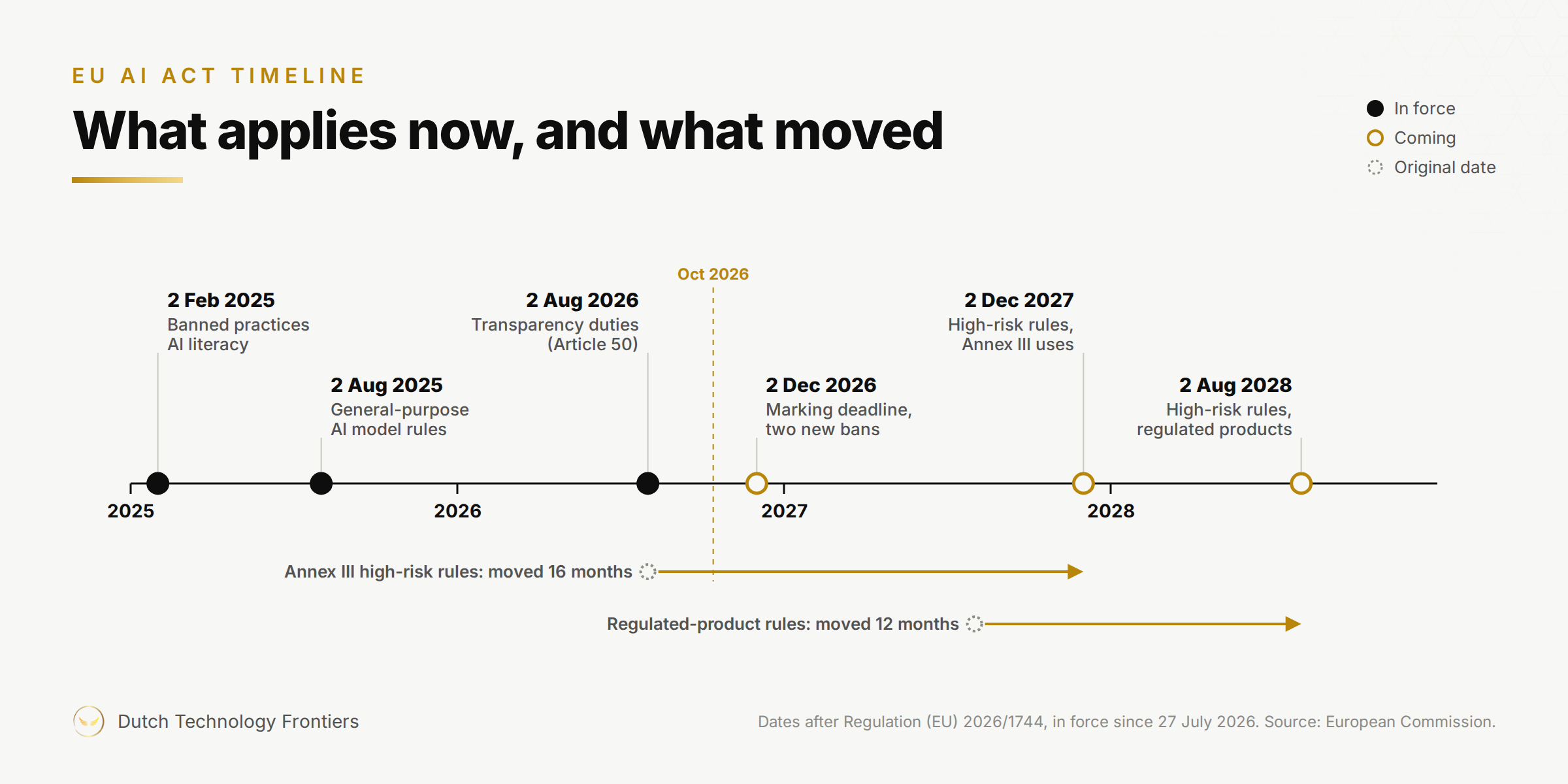
The timeline changed this year. The Commission proposed an "AI Omnibus" in November 2025 to simplify the Act, a provisional political agreement was reached on 7 May 2026, and it entered into force on 27 July 2026 as Regulation (EU) 2026/1744. Its biggest effect: the high-risk rules that were due on 2 August 2026 now start on 2 December 2027.
Date | What applies | Status |
|---|---|---|
2 February 2025 | Banned AI practices; AI literacy | In force |
2 August 2025 | Rules for providers of general-purpose AI models; national penalty rules | In force |
2 August 2026 | Transparency duties (Article 50) | In force |
2 December 2026 | Machine-readable marking deadline for generative systems already on the market before 2 August 2026; new bans on non-consensual intimate imagery and child sexual abuse material | Coming |
2 December 2027 | High-risk rules for Annex III uses, such as hiring, credit scoring and education (was 2 August 2026) | Coming |
2 August 2028 | High-risk rules for AI built into regulated products, such as medical devices and lifts (was 2 August 2027) | Coming |
Two details are easy to miss. AI literacy still applies, but the amendment softened it: companies now have to take measures to support AI literacy among staff, rather than ensure a sufficient level. And the delay only covers high-risk rules. The transparency duties started on schedule.
What the transparency duties mean for an agent
Article 50 has applied since 2 August 2026. For agents, four parts matter most (it also requires deployers of emotion recognition or biometric categorisation to inform the people exposed to it):
Say it's AI. Providers have to design agents that interact directly with people so those people are told they're dealing with an AI system, unless that's obvious to a reasonably well-informed person.
Mark what it generates. Systems that generate synthetic audio, images, video or text have to mark their output in a machine-readable way, so it can be detected as AI-generated. Systems that only assist with standard editing, or don't substantially change the input, are exempt.
Disclose deepfakes. Deployers have to disclose image, audio or video content that is artificially generated or manipulated to look real. For clearly artistic, satirical or fictional work, a lighter disclosure is enough.
Label AI-written public-interest text. Deployers publishing AI-generated text to inform the public on matters of public interest have to disclose it, unless a person reviewed it and someone holds editorial responsibility.
For most customer-facing agents, the first point is the one to check today: does every chat, voice call or email from your agent make clear that it's AI?
How to classify your agent in five steps
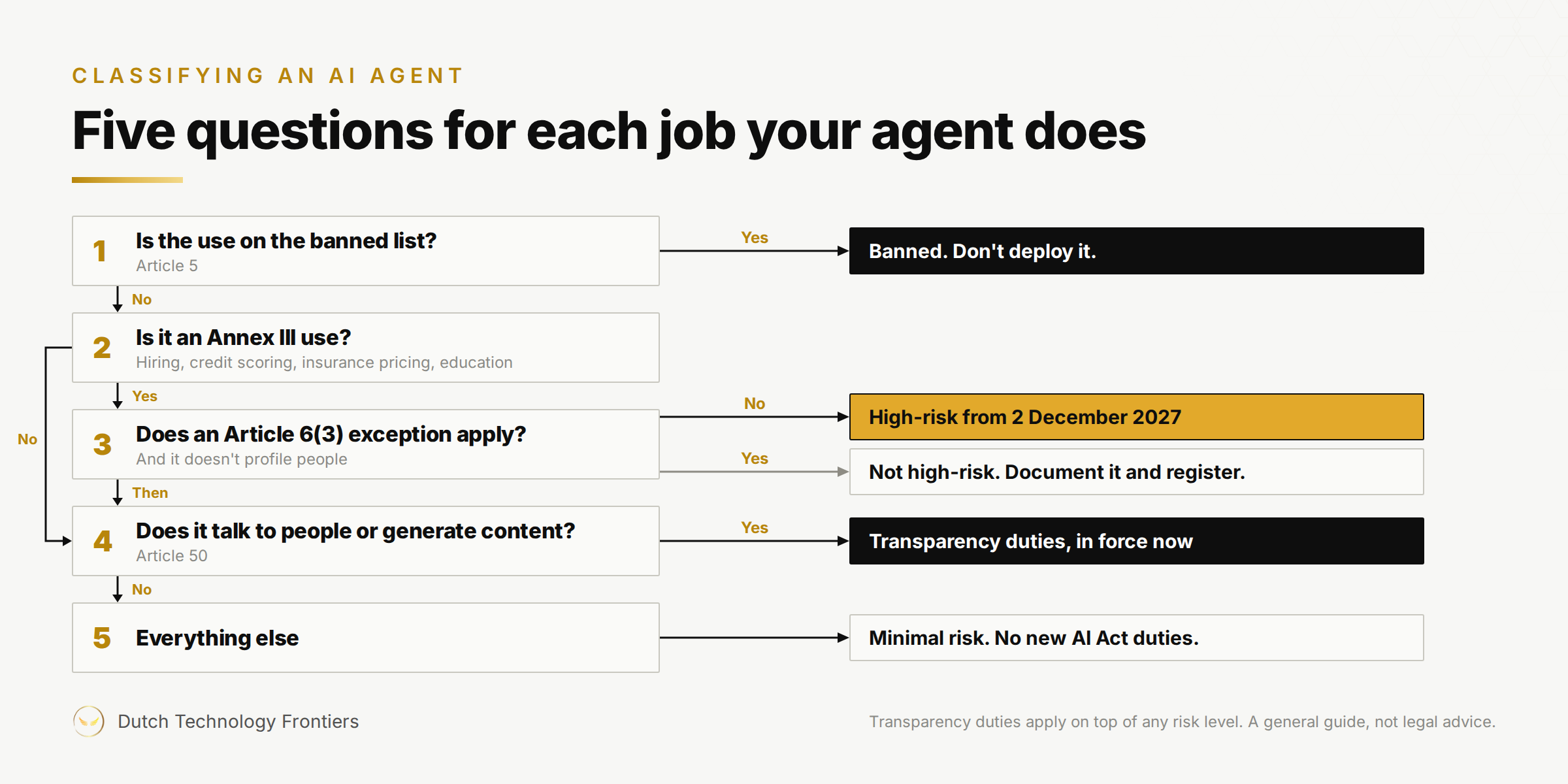
Work through each agent separately, and each job it does, because the use decides the category.
Check it isn't banned. Article 5 prohibits a short list of practices, including manipulative techniques that cause, or are reasonably likely to cause, significant harm, social scoring, and inferring people's emotions at work or in education (except for medical or safety reasons). An agent that monitors employees' mood on calls is the kind of use to rule out early.
Check the high-risk areas. Annex III lists eight areas. The ones agents most often touch are employment (screening applications, evaluating candidates, allocating tasks based on behaviour or personal traits, monitoring performance), access to essential services (credit scoring other than fraud detection, risk assessment and pricing for life and health insurance), and education (admissions, evaluating learning outcomes).
Check the exception. Under Article 6(3), an Annex III system isn't high-risk if it poses no significant risk of harm and meets one of four conditions: it does a narrow procedural task, improves the result of work a person has already completed, detects patterns in decisions without replacing proper human review, or does a preparatory task. Any Annex III system that profiles people is always high-risk. A provider relying on the exception has to document its assessment, register the system and show the documentation to authorities on request.
Check the transparency duties. If the agent talks to people or generates content, Article 50 applies, whatever its risk level.
Everything else is minimal risk. The AI Act adds no new obligations there. GDPR and your sector's own rules still apply.
Write down the result and the reasoning for every agent. That record is what a regulator, an auditor or a buyer will ask for.
What the fines look like
Article 99 sets the maximum fines. These are ceilings, not set amounts. For companies, the cap is whichever of the two figures is higher. For SMEs and start-ups, it's whichever is lower.
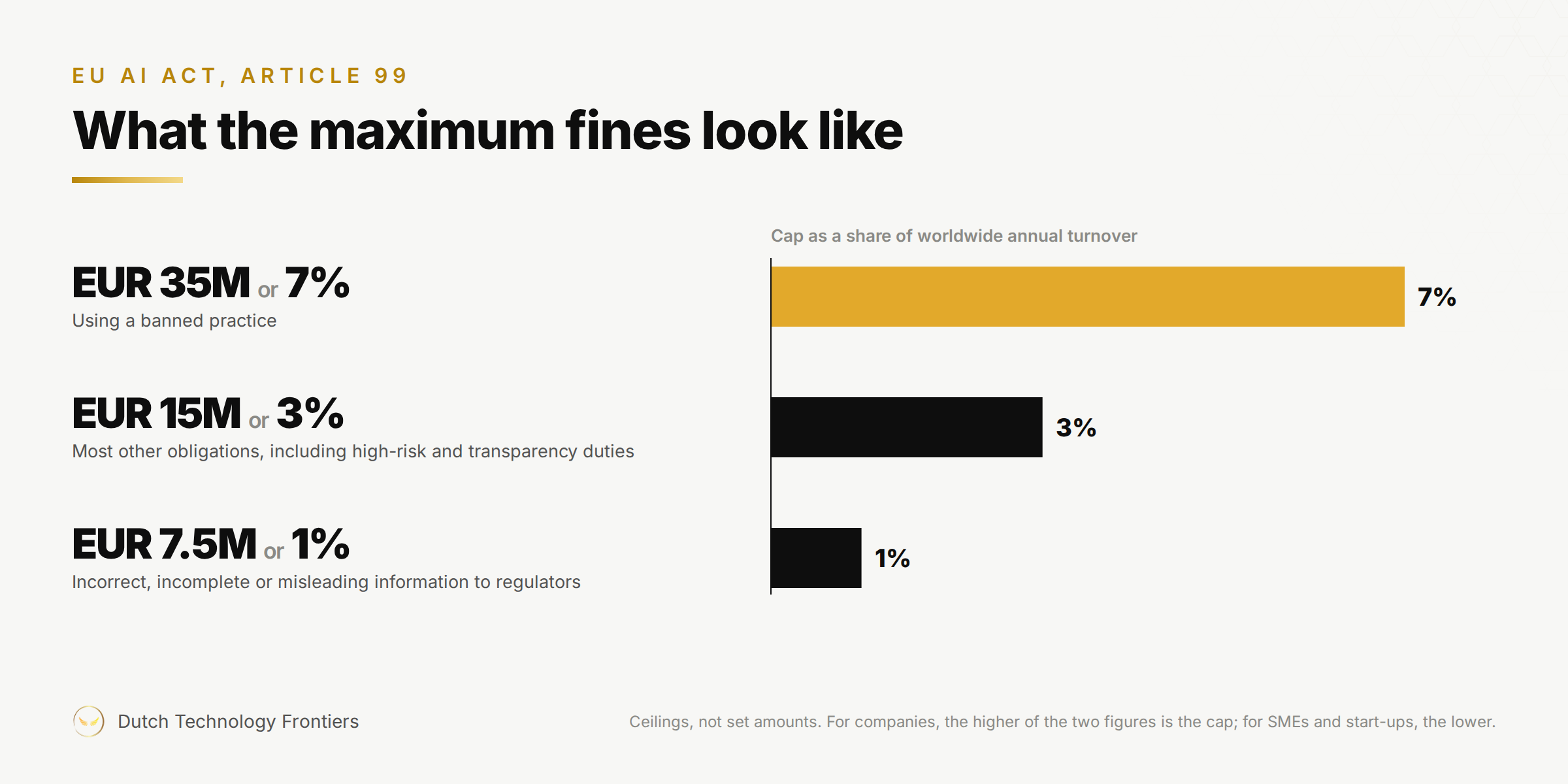
Breach | Maximum fine |
|---|---|
Using a banned practice | EUR 35 million or 7% of worldwide annual turnover |
Most other obligations, including high-risk and transparency duties | EUR 15 million or 3% of worldwide annual turnover |
Giving regulators incorrect, incomplete or misleading information | EUR 7.5 million or 1% of worldwide annual turnover |
What to do in the next 14 months
The Annex III deadline is 2 December 2027, just under 14 months away. High-risk systems need risk management, data governance, technical documentation, logging, information for deployers, human oversight, and accuracy, robustness and security, and none of that is quick to retrofit.
List every agent you build or use, what it does, who it affects, and which model provider sits underneath.
Classify each one with the five steps above, and keep the reasoning.
Fix transparency now. Those duties already apply. Check that every agent tells people it's AI, and that generated media is marked.
Start on high-risk work early for anything that lands in Annex III, beginning with logging and human oversight. Both are hard to add to an agent after it's built.
Check what your model provider gives you. Providers of general-purpose AI models have their own obligations, including documentation for the companies building on them. Ask for it.
Put AI literacy measures in place for the people who build, run and supervise your agents.
Why this matters in a deal
In a technology due diligence, an AI agent working in an Annex III area is an obligation with a date on it. If the target's agent screens candidates or scores credit, the buyer inherits the work needed to make it compliant by December 2027, and the cost of that work belongs in the valuation.
The questions to ask are straightforward. Which agents does the company run, and what does each one decide? Has anyone classified them, and is the reasoning written down? Is the company the provider, the deployer or both? Are the transparency duties already met? Like the running cost of an AI agent, this is far easier to answer before signing than after.
FAQ
Does the EU AI Act apply to AI agents? Yes, when the agent meets the Act's definition of an AI system, which most do. There's no separate category for agents; the obligations depend on what the agent is used for.
When do the high-risk rules apply? From 2 December 2027 for Annex III uses such as hiring and credit scoring, and from 2 August 2028 for AI built into regulated products. Both dates were pushed back by the 2026 amendment.
Does the EU AI Act apply to companies outside the EU? Yes, if they place AI systems on the EU market, or if their system's output is used in the EU.
Is a customer service chatbot high-risk? Not usually on its own. It does have to tell people they're talking to an AI. If the same agent also decides access to something Annex III covers, such as credit, that part of its work is high-risk.
What are the fines? Up to EUR 35 million or 7% of worldwide annual turnover for banned practices, and up to EUR 15 million or 3% for most other breaches, whichever is higher. For SMEs, the lower figure is the cap.
Running AI agents in Europe, or buying a company that does? Talk to us about classifying them and closing the gaps before December 2027.
This article is a general overview as of 13 October 2026 and isn't legal advice. Check your own obligations with qualified counsel.
Sources: Regulation (EU) 2024/1689, consolidated articles, European Commission: AI Act, Regulation (EU) 2026/1744.