
How much does an AI agent cost to run? A worked example with October 2026 prices
Ask a model provider what an AI agent costs and you get a price per million tokens. Ask a finance team six months after launch and you often get a very different number.
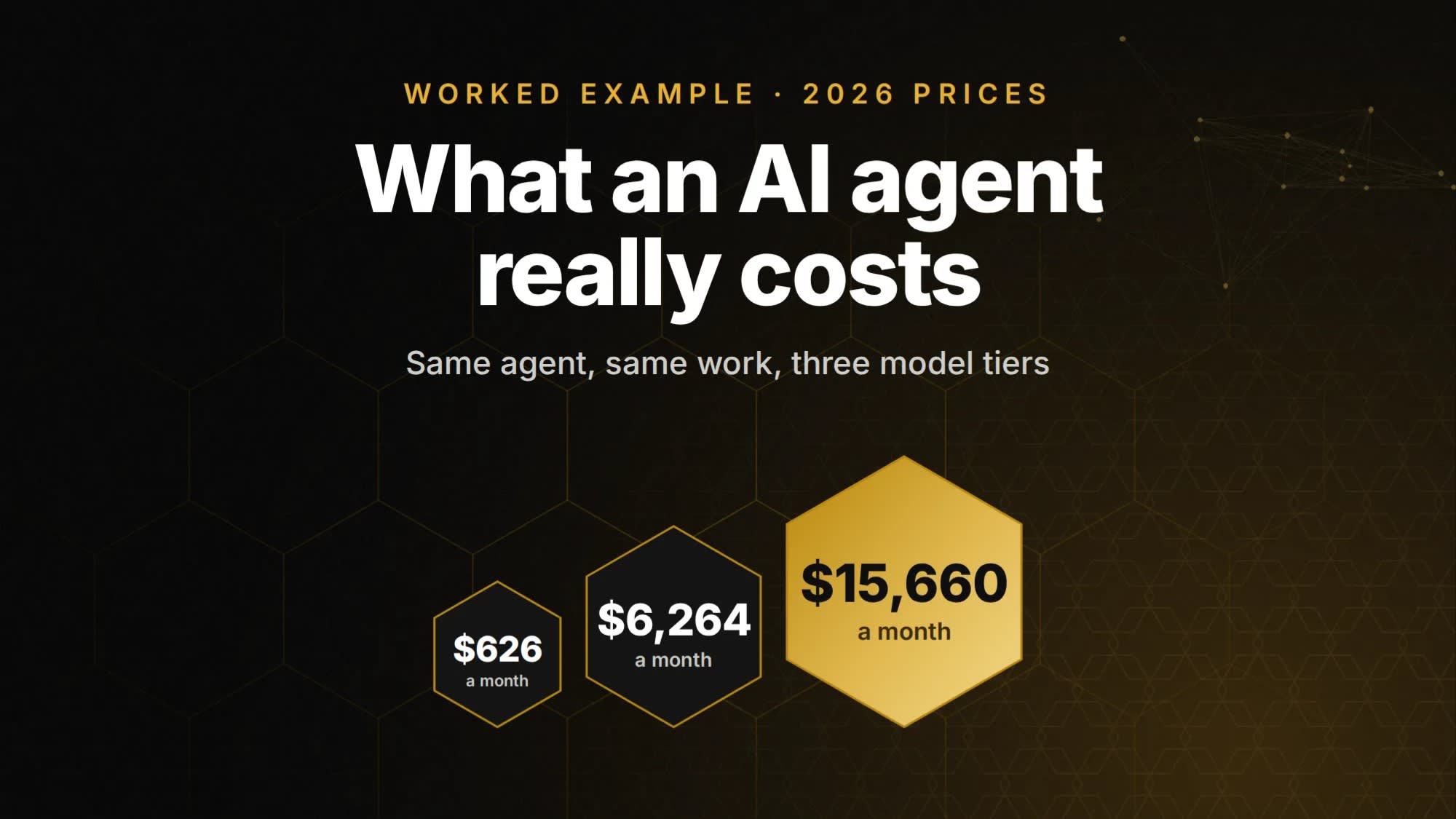
The gap comes from how agents work, not from the price list. The same agent doing the same work can cost $626 a month or $15,660 a month depending only on the model tier it runs on. Below we work through one example with published prices, show where the money goes, and cover the costs that never appear on the token bill.
Cost isn't a side issue. Gartner predicts that over 40% of agentic AI projects will be canceled by the end of 2027, citing escalating costs, unclear business value or inadequate risk controls.
Why an agent costs more than a chatbot
A chatbot answers once. An agent works in a loop: it reads the task, picks a step, calls a tool such as a search, a database or an API, reads the result and decides what to do next. It repeats that until the job is done, and every step is a separate call to the model.
Models don't remember earlier calls. So on every step the agent sends everything again: its instructions, the definitions of the tools it can use, and the whole conversation so far. The input grows with each step, and you pay for the same tokens over and over.
Providers charge per token, roughly a piece of a word, with separate prices for input and output. Output costs more per token. Some models also reason before they answer, and OpenAI bills those hidden reasoning tokens as output tokens even though you never see them.
A worked example: a support agent handling 1,000 tickets a day
Take a customer support agent that reads a ticket, looks things up in a few systems and drafts a resolution. These are illustrative assumptions, not figures from a client:
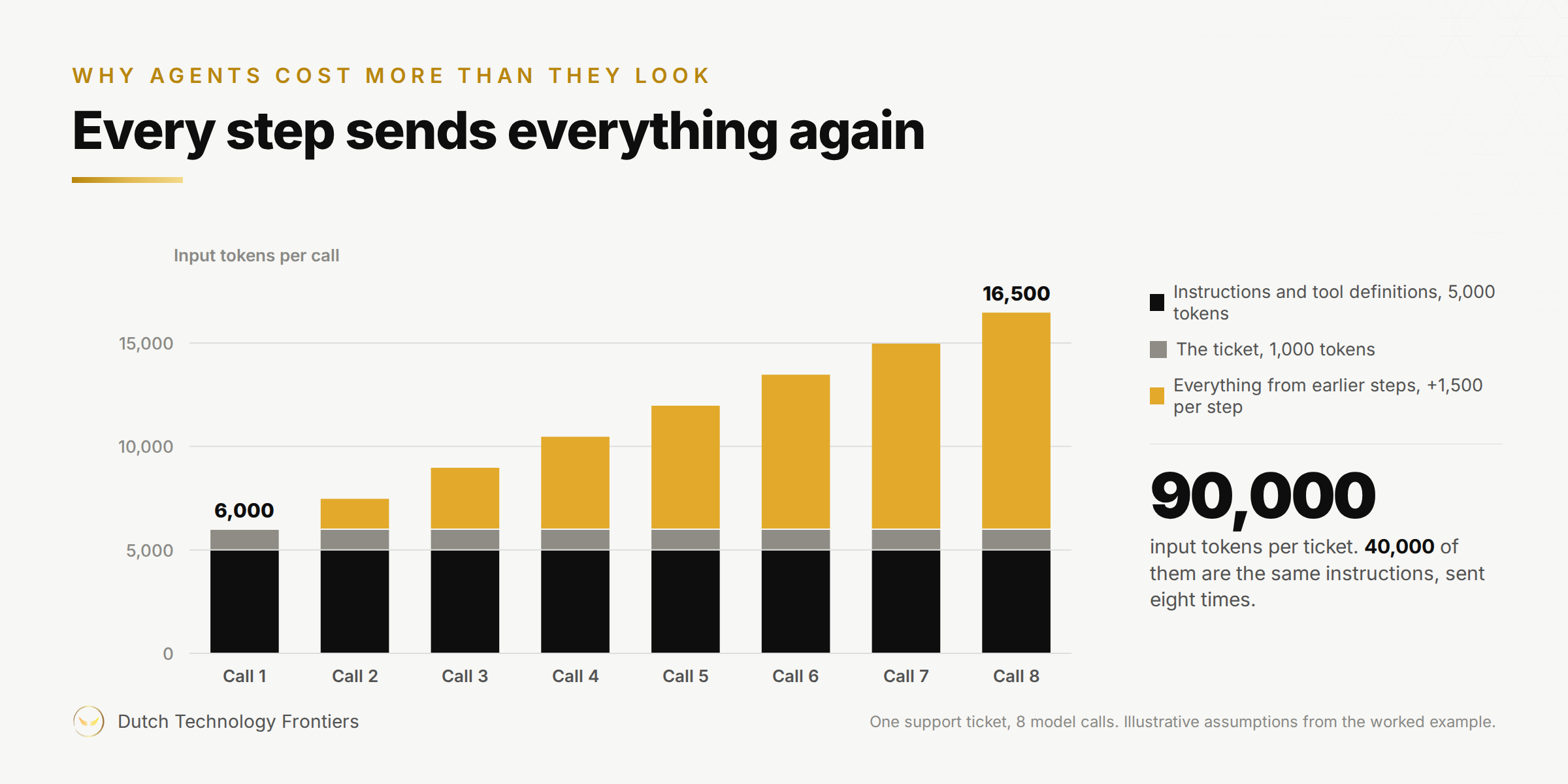
8 model calls per ticket
5,000 tokens of instructions and tool definitions, the same on every call
1,000 tokens for the ticket itself
1,500 new tokens added at each step (a tool result plus the agent's previous reply)
300 output tokens per call, with little hidden reasoning (a model that reasons at length bills those tokens as output, which raises every figure below)
1,000 tickets a day, or 30,000 a month
The first call sends 6,000 tokens. By the eighth call the agent sends 16,500, because everything before it comes along. Across the eight calls that's 90,000 input tokens and 2,400 output tokens per ticket. The fixed instructions alone, sent eight times, make up 40,000 of those 90,000 input tokens.
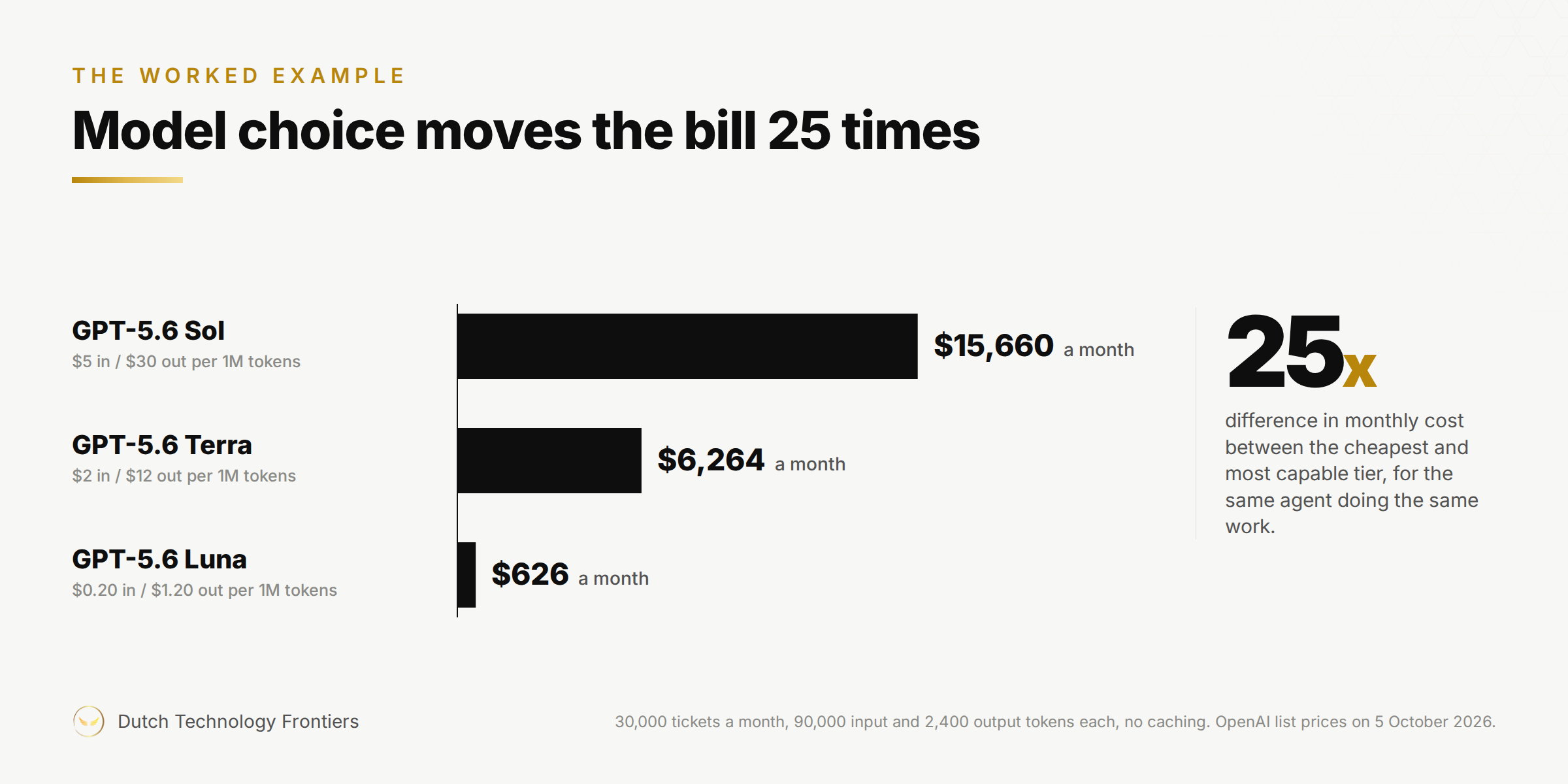
Here's what that costs on OpenAI's three current GPT-5.6 tiers, at the prices published on 5 October 2026:
Model | Input (per 1M tokens) | Output (per 1M tokens) | Cost per ticket | Cost per month (30,000 tickets) |
|---|---|---|---|---|
GPT-5.6 Sol | $5.00 | $30.00 | $0.52 | $15,660 |
GPT-5.6 Terra | $2.00 | $12.00 | $0.21 | $6,264 |
GPT-5.6 Luna | $0.20 | $1.20 | $0.02 | $626 |
Two things stand out.
86% of the bill is input, not output, even though output costs six times more per token. The agent doesn't spend its money writing. It spends it re-reading.
Model choice moves the bill by 25 times. Other providers sit in the same bands. Anthropic lists Claude Sonnet 5.5 at $2 per million input tokens and $10 per million output, and Google lists Gemini 3.5 Flash at $1.50 and $9.00.
Four levers that cut the bill
1. Cache the parts that repeat. Prompt caching lets the provider reuse the start of a prompt it has already processed, at a fraction of the price. On GPT-5.6 Terra, cached input costs $0.20 per million tokens instead of $2.00. OpenAI's caching rules for GPT-5.6 and later: the prompt needs at least 1,024 tokens, writing to the cache costs 1.25 times the normal input rate, a cached prefix stays active for at least 30 minutes after it was last used, and the whole prefix has to match exactly. Anthropic works the same way, with cache reads at a tenth of the base input price on most models.
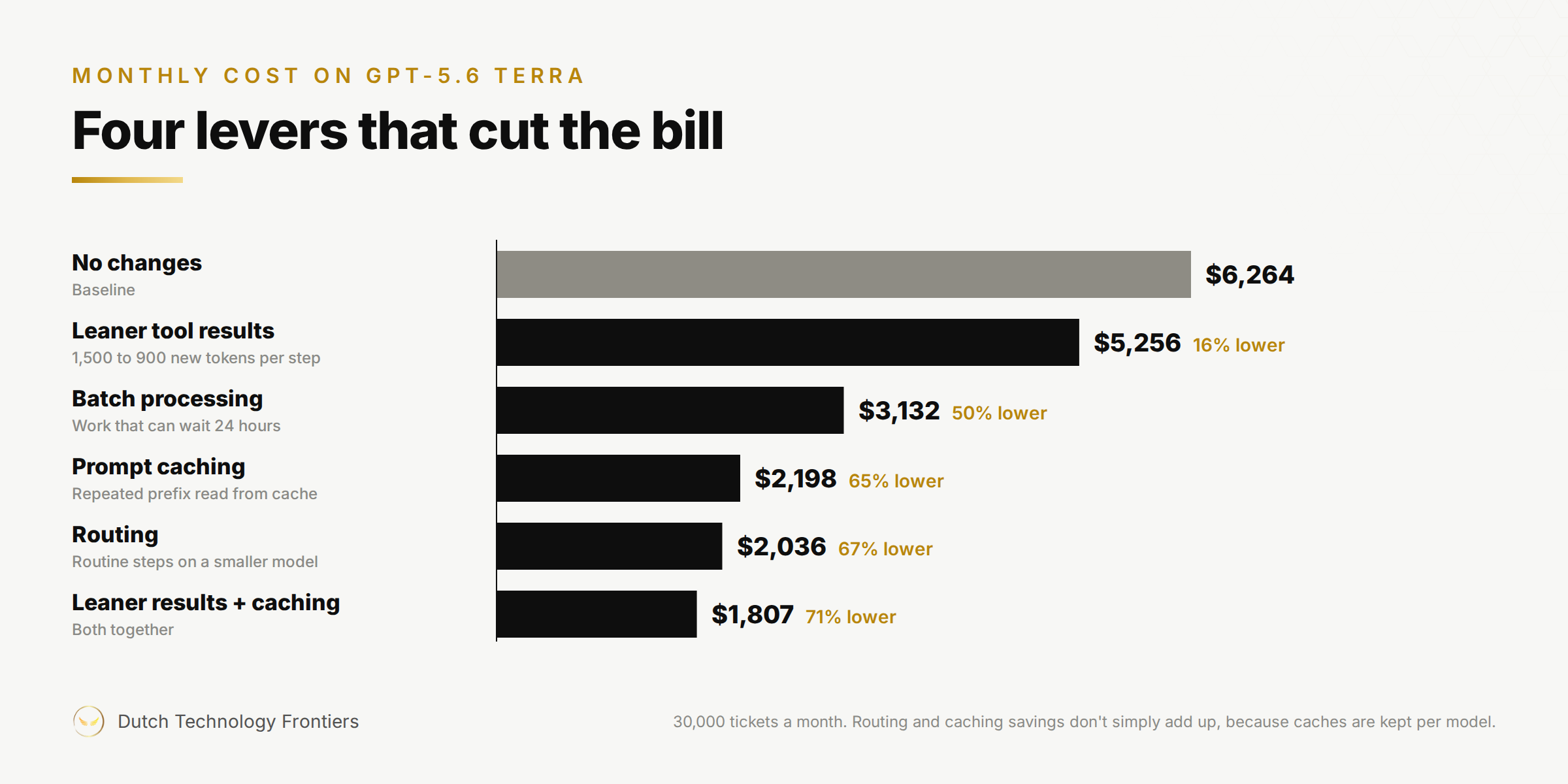
In our example, if the instructions and earlier steps come from the cache, only 11,500 of the 90,000 input tokens per ticket are new. On Terra, the cost per ticket falls from $0.21 to $0.07, and the month from $6,264 to $2,198, a 65% cut. That assumes steady traffic keeps the cache warm, and it charges every new token at the cache-write rate, so it's on the cautious side. The practical rule: put what never changes (instructions, tool definitions) at the start of the prompt and what changes (the ticket) at the end. A timestamp at the top of a prompt can stop everything after it from being cached.
2. Send each step to the cheapest model that can do it. Not every step needs the top model. If the first call (planning) and the last call (the final answer) run on Terra and the six routine tool steps run on Luna, the cost per ticket drops to about $0.07 and the month to $2,036, before any caching. The catch is that you only know a smaller model is good enough by testing it on real tasks, which is what evals are for. Caches are also kept per model, so switching models mid-task gives up part of the caching saving. Don't add the two savings together.
3. Keep the context lean. Every token that enters the conversation is paid for again on every later step. Trim tool results down to the fields the agent actually needs. Cutting the new content per step from 1,500 to 900 tokens lowers the Terra cost per ticket by 16%. Combined with caching, the month comes to $1,807.
4. Use batch for work that can wait. OpenAI, Anthropic and Google all offer 50% off for batch processing. OpenAI's batch jobs run asynchronously over 24 hours, so they suit overnight document processing or back-office checks, not a customer waiting for an answer. Run in batch without caching, the Terra example would cost $3,132 a month.
The costs that never show up on the token bill
Tokens are the easiest part to model, and often not the largest. Before an agent survives production, budget for:
Evaluation: a set of real test tasks, rerun every time you change a prompt or a model.
Observability: logging and tracing each step, so you can see why a run went wrong and what it cost.
Human review: the cases the agent hands back, plus spot checks on the ones it didn't.
Integration and security: access to the systems the agent acts on, with permissions limited to what it needs.
Price and model changes: providers retire models and change prices, and each change means retesting. Google's own price list already shows Gemini 3.8 Flash doubling on 1 January 2027, from $0.75 to $1.50 per million input tokens and from $3.75 to $7.50 per million output.
Then make the comparison that matters. Set the agent's full cost per completed task against what the task costs today: minutes per ticket multiplied by the hourly cost of the person doing it. If the agent isn't clearly cheaper per resolved ticket, cheaper tokens won't rescue it.
A checklist before you scale an agent
Measure tokens per completed task, not per call.
Find out what share of each prompt repeats, and cache it.
Price each step, and send routine steps to smaller models.
Cap how much each tool can return.
Rerun your evals before every model or prompt change.
Track cost per completed task next to accuracy.
Watch your providers' price pages for scheduled changes.
Why this matters in due diligence
When we assess a company whose product runs on AI, one of the questions we ask is what each AI component costs to run per customer. A product that looks profitable at demo volume can look very different once the agent loop is multiplied by real usage. The worked example above shows how to start answering it.
FAQ
How much does an AI agent cost per month? It depends on tasks per month, steps per task, context size and the model. In our example, 30,000 tasks a month cost anywhere from $220 to $15,660, depending on the model tier and whether caching is used.
Why is input most of the cost? Because every step resends the instructions, the tool definitions and the conversation so far. In our example, input is 86% of the bill.
Is the cheapest model always the cheapest option? Not per completed task. If a smaller model fails more often, retries and human fixes can cost more than the tokens you saved. Test it on real tasks first.
How do I estimate the cost before building? For each model call in a typical task, multiply input tokens by the input price and output tokens by the output price, then add the calls together. Multiply by tasks per month, then add the costs beyond tokens.
Planning an agent, or assessing a company that runs one? Talk to us and we'll help you work out what it will really cost to run.