
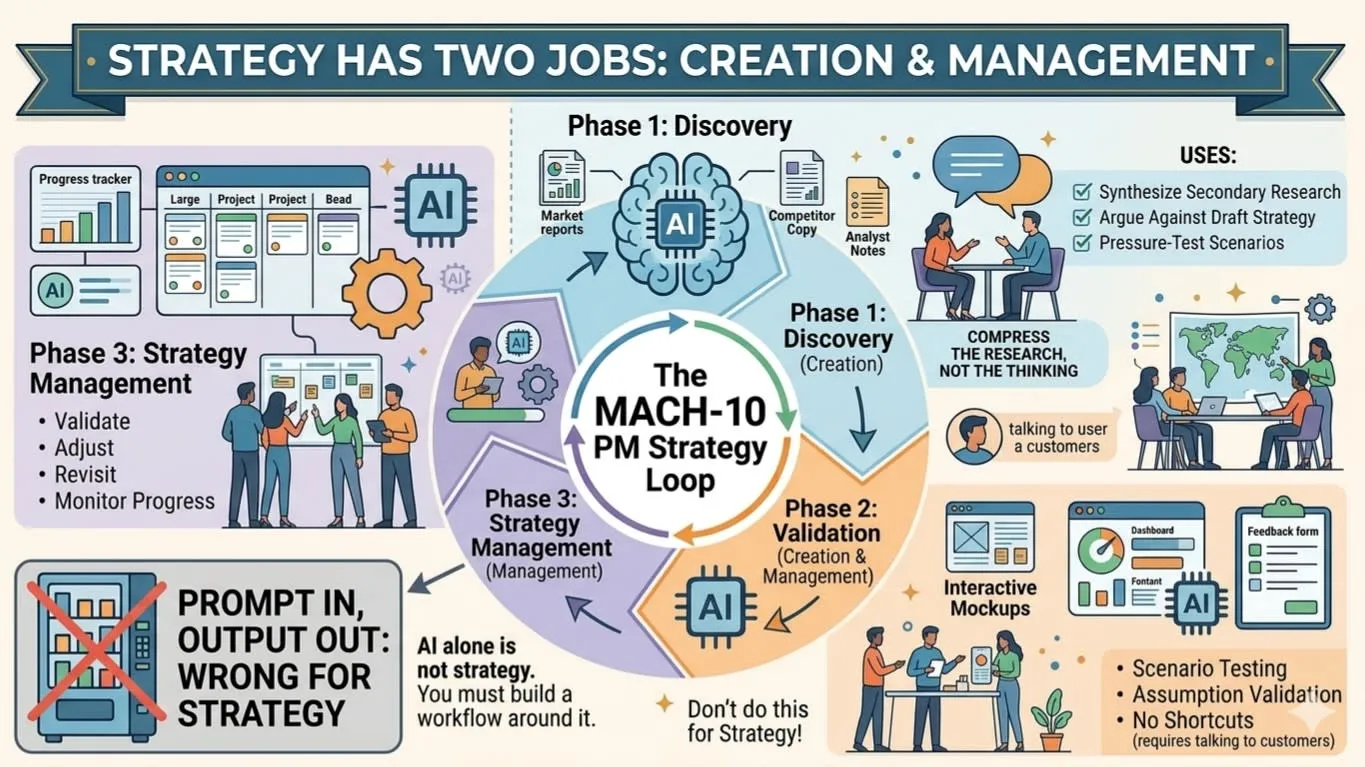
Most product people I talk to use AI like a vending machine. Prompt in, output out, move on.
That works for release notes. It doesn't work for strategy.
Strategy is where I've seen the sharpest teams waste the most time, not because they're using the wrong tools, but because they haven't built a process around the tools they have. AI doesn't give you better strategy. It gives you better strategy when you build a workflow around it first.
That's the thing nobody says out loud.
The Core Idea: Strategy Has Two Jobs, Not One
Before touching any tool, you have to understand what you're actually doing.
Product strategy runs in two modes:
Creation: figuring out direction, target user, core problem, why now
Management: validating, adjusting, and revisiting that direction as things change
Most teams blur these together. They shouldn't. Creating strategy is a discovery process. Managing it is a monitoring and correction process. AI helps with both, but differently. If you don't know which mode you're in, you'll use the tool wrong and wonder why the output feels hollow.
Jason Riggs calls this a "strategy loop" in The MACH-10 PM. The loop has to exist before the AI fits inside it. That sequence matters.
3 Phases Where AI Earns Its Place
1. Discovery: Compress the Research, Not the Thinking
The front end of strategy is messy: market research, competitor mapping, customer problem framing. AI is good at compressing this without replacing it.
What I actually use it for:
Synthesizing secondary research fast (reports, competitor copy, analyst notes)
Arguing against my own draft strategy, "what would a skeptical board member say?" is a prompt I run every time
Pressure-testing scenarios where my current assumptions have no good answer
What it can't do: tell you if the opportunity is real. That still requires talking to customers. No shortcut.
2. Validation: Stop Rushing This Step
This is where I see the most mistakes. Teams land on a direction that feels right and move straight to execution. Validation becomes a formality.
What I do instead: paste the draft strategy into Claude, ask it to identify the three assumptions the strategy would fail without, then ask what evidence would confirm or kill each one. You get a testable hypothesis list in under ten minutes. That's what you need to actually run experiments.
One thing worth naming: if your product has AI features, ethical risk assessment belongs in the strategy document, not in a retrospective after something goes wrong. Who could be harmed by how this system decides? What's the environmental cost at scale? These are strategy questions, not engineering ones. Roman Pichler covers this well in his work on product ethics and AI strategy
3. Management: The Part That Never Stops
Once the product is live, the work shifts to monitoring. Is this working? Is the market behaving as expected?
AI helps with:
Aggregating signal across support tickets, usage data, feedback, competitor moves.
Watching for disruption: patent filings, early startup activity, fringe customer requests. About 10% of strategic attention should sit here. Most teams give it zero. The Innovation Ambition Matrix is a useful frame for thinking about where that attention goes
Keeping the strategy document alive. Confluence pages go unread. AI can flag where current assumptions conflict with new information before the gap becomes a crisis
The Time Commitment: Honest Version
AI compresses strategy work. It doesn't eliminate it.
What I actually allocate: roughly four hours a week on strategy tasks, plus two hours per quarter for a proper workshop with stakeholders and the dev team. That's where strategy gets reality-checked by people who weren't in the room when you wrote it.
Not a lot of time. But it has to actually happen. "We'll do it when things slow down" is how strategy disappears until there's a crisis.
One Mindset Shift That Changes How You Use These Tools
AI tools don't have a stake in your product's success. They generate confident output regardless of whether the reasoning underneath is sound.
The teams that use this well treat AI like a capable analyst who needs managing, not an oracle who needs following. Interrogate the output. Push back on it. Use it to surface what you haven't thought about, then apply your own judgment to what actually matters.
That's the whole game.
Bottom Line: The Actual Takeaway
→ Build the strategy loop first (creation → validation → management)
→ Use AI to compress research, stress-test assumptions, and monitor for drift
→ Don't skip validation, and don't treat ethical risk as someone else's problem
→ Allocate real time. Four hours a week is the floor, not the ceiling
→ Treat AI as an analyst, not an answer machine
The teams winning at this aren't the ones with the cleverest prompts. They're the ones who built a process and fitted the tools inside it. Start with the loop. Everything else follows.
If you're building an AI-native product workflow and want to compare notes, I'm always up for it, reach out.

Sabeel works where AI-first development meets operational strategy. He has managed a €50M+ portfolio and scaled data-driven products across retail, finance and tech.
Sabeel on LinkedIn