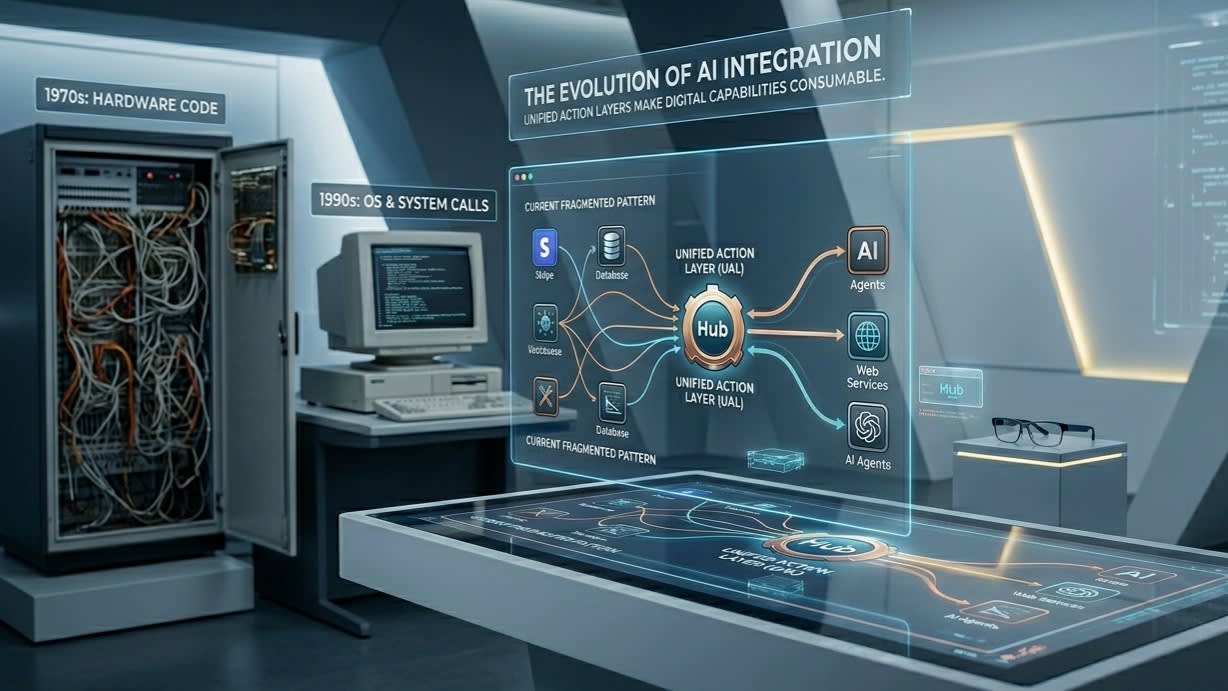
In 1995, saving a file required a single fwrite() call. In 1975, the same operation demanded direct hardware manipulation through assembly code. This transformation illustrates computing's fundamental pattern: complex capabilities become consumable through abstraction layers.
Operating systems established the first major consumability layer, converting hardware complexity into standardized system calls. The web followed with HTTP and HTML, abstracting network protocols into simple resource requests. The API economy continued this trend, with services like Stripe and Twilio wrapping complex financial and telecommunications infrastructure into REST endpoints.
Technical Standards and Market Adoption
Market success consistently favors consumability over technical sophistication. REST APIs defeated SOAP despite SOAP's superior feature set and enterprise backing. JSON supplanted XML despite XML's schema validation capabilities. These outcomes demonstrate that adoption ease trumps technical complexity.
The Current AI Integration Challenge
Today's AI integrations exhibit the same fragmentation that preceded previous consumability layers. Organizations implement bespoke solutions across different models, orchestration frameworks, and tool interfaces. Each agent requires custom adapters, authentication handling, and output normalization across dozens of integration points.
Model Context Protocol and Unified Action Layers
The Model Context Protocol (MCP) represents an early standardization effort, establishing structured handshakes between AI agents and external tools. However, the industry trajectory points toward broader unified action layers (UAL).
Consider how a tool like Cursor demonstrates the power of unified interfaces: developers can change settings through traditional APIs, interact with intuitive UI elements, or simply converse with their chat interface to accomplish the same task. This multi-modal approach to the same underlying capability hints at the broader potential of unified action layers—imagine extending this pattern across all digital infrastructure.
Consider the contrast between current implementation patterns:
Traditional API Integration
// Direct API call
const paymentResult = await stripe.charges.create({
  amount: 2000,
  currency: 'usd',
  source: 'tok_visa'
});

// Database query
const userData = await db.query('SELECT * FROM users WHERE id = ?', [userId]);

// UI automation
await page.click('#submit-button');
MCP Tool Discovery
// MCP tool registration
{
  "tools": [
    {
      "name": "process_payment",
      "description": "Process payment transaction",
      "inputSchema": {
        "type": "object",
        "properties": {
          "amount": {"type": "number"},
          "currency": {"type": "string"}
        }
      }
    }
  ]
}
Unified Action Layer
// Single interface for all capabilities
const result = await ual.invoke('process_payment', {
  amount: 2000,
  currency: 'usd',
  source: 'tok_visa'
});

const userData = await ual.invoke('query_user_data', {userId});

const uiResult = await ual.invoke('click_element', {selector: '#submit-button'});
Technical Implications
Unified action layers provide several architectural advantages:
Observability: Centralized action flow enables comprehensive tracing and debugging across all agent interactions
Security: Access control and authentication enforcement at the layer level rather than per integration
Composability: Agent chaining without custom connectors for each capability combination
Versioning: Interface stability allows independent service evolution
Agent Composition at Scale
The most significant implication involves seamless agent composition. When all capabilities expose consistent interfaces, procurement agents can transition to compliance agents, which escalate to human approval workflows, which trigger ERP updates—without bespoke integration code.
This composability transforms agent architecture from point-to-point connections to orchestrated workflows, reducing complexity overhead and enabling rapid capability expansion.
Strategic Implications
Historical precedent suggests that unified action layers represent an inevitable convergence rather than a speculative development. Organizations that recognize and build upon this emerging consumability layer will gain significant competitive advantages, similar to early adopters of REST APIs, cloud platforms, and mobile ecosystems.
The defining factor will not be technical sophistication but consumability—whichever approach makes it easiest for agents to invoke capabilities and chain operations will establish market dominance.
At Dutch Technology Frontiers, we develop deep workflow tools that enable human-agent collaboration through unified action layers and MCP implementations, positioning clients for the next evolution in intelligent automation.