Most conversations at work rely on something we rarely think about: memory.
Imagine a conversation between a manager and a colleague.
The manager asks, “Where are we with the Johnson proposal?”
The colleague replies, “They pushed back on the pricing last week. Sarah joined the call and we agreed to revise it.”
The manager responds, “Okay. Change the discount to 15%, prepare it the way we normally do, and remind me Tuesday morning if Sarah hasn’t approved it.”
A good colleague understands all of this immediately.
They know what you are currently discussing. They know who Sarah is. They remember what happened last week. They know how proposals are normally prepared. They bring their existing knowledge and experience to the task. And they remember that something needs to happen on Tuesday.
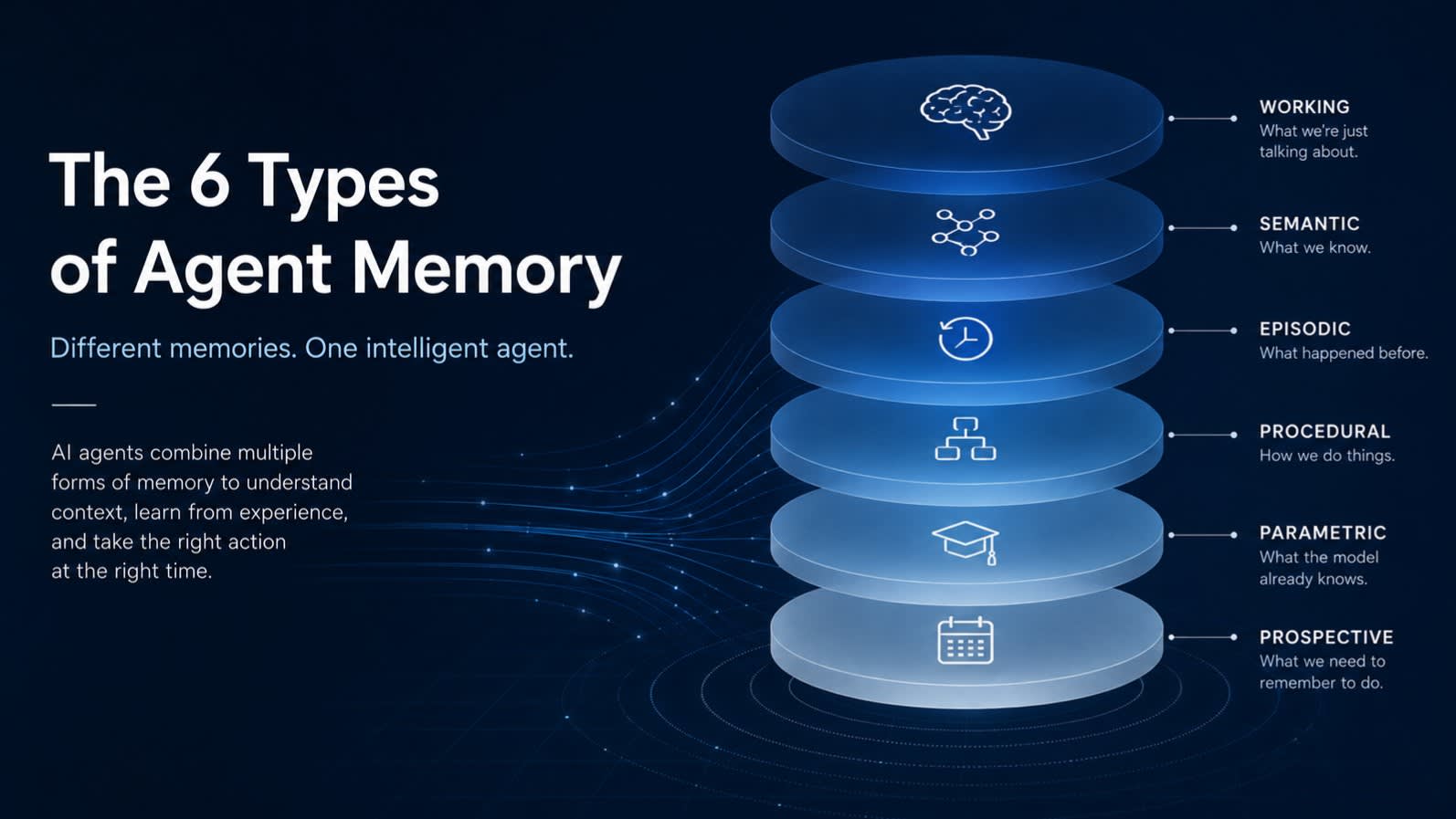
For an AI agent to operate in a similar way, one type of memory isn’t enough.
It needs several.
1. Working Memory
What we’re just talking about
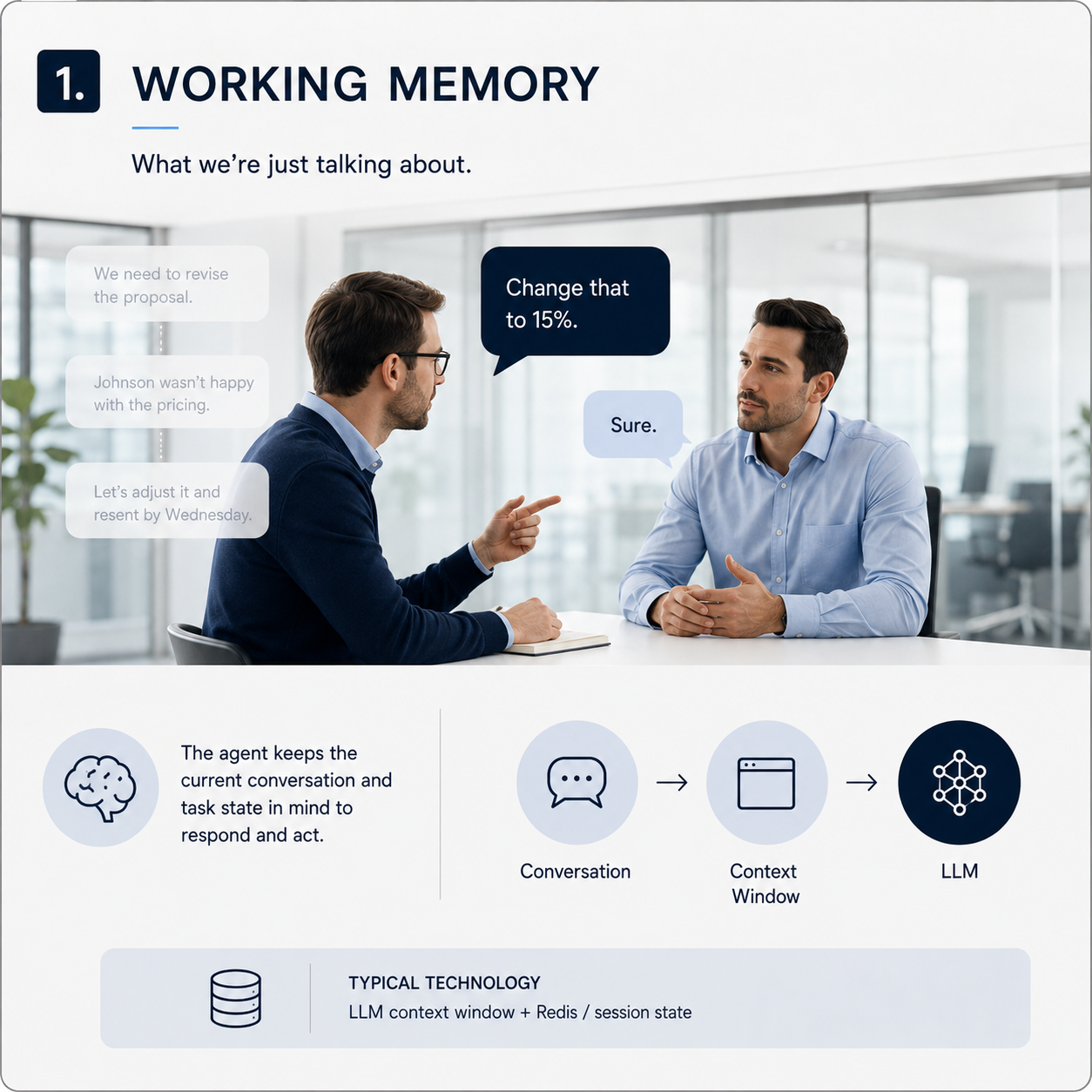
Imagine the manager says, “We need to revise the proposal. Johnson wasn’t happy with the pricing.”
A few sentences later, they simply say, “Change that to 15%.”
The colleague does not ask, “15% of what?”
The current conversation is still in their head.
That is working memory.
For an AI agent, working memory contains the information it needs right now. This might include the current conversation, the task being performed, recently retrieved information and the results of tools it has just used.
Technically, much of this information can live inside the LLM’s context window, sometimes supplemented by temporary session state using technology such as Redis.
Working memory is fast and immediately useful, but deliberately temporary. Just as a human does not actively hold every conversation they have ever had in their mind, an AI agent should not attempt to place everything it knows into every prompt.
2. Semantic Memory
What we know
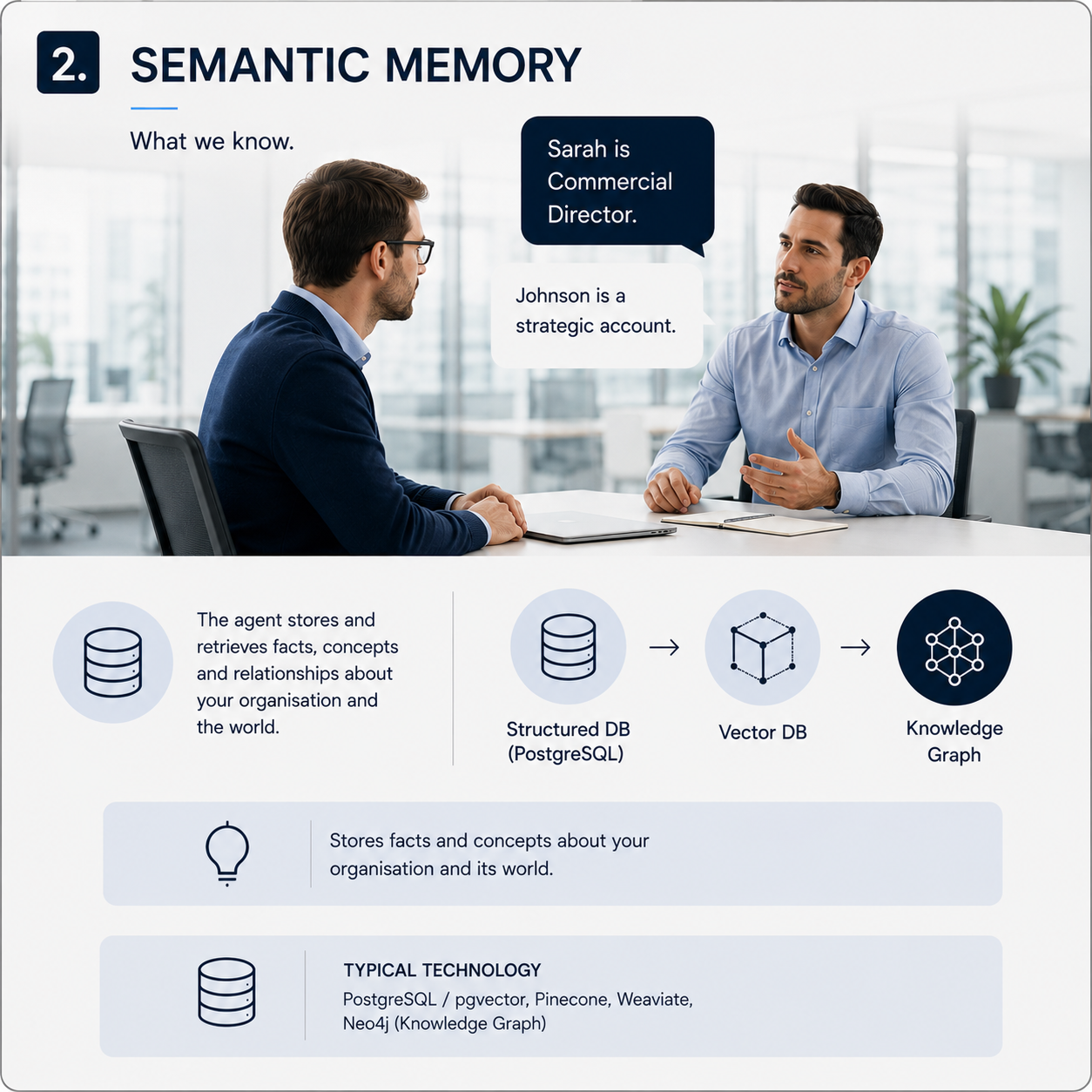
Now imagine someone says, “Sarah needs to approve this.”
Nobody asks who Sarah is.
The team already knows that Sarah is the Commercial Director. They might also know that Johnson is a strategic account, that enterprise proposals require commercial approval and that this particular customer prefers quarterly billing.
These are not necessarily memories of particular conversations. They are facts the organisation knows.
That is semantic memory.
For an AI agent, semantic memory can contain information about customers, employees, products, contracts, terminology, policies and relationships across the organisation.
The technology used to store this information depends on what kind of knowledge it is.
Structured information can live in a relational database such as PostgreSQL. Documents and less structured organisational knowledge can be indexed using vector technology such as pgvector, Pinecone or Weaviate. Where relationships between people, companies, products and concepts become particularly important, a knowledge graph such as Neo4j can also be useful.
The objective is not to give the AI everything the organisation knows every time it receives a request. The objective is to retrieve the right organisational knowledge when it becomes relevant.
3. Episodic Memory
What happened before
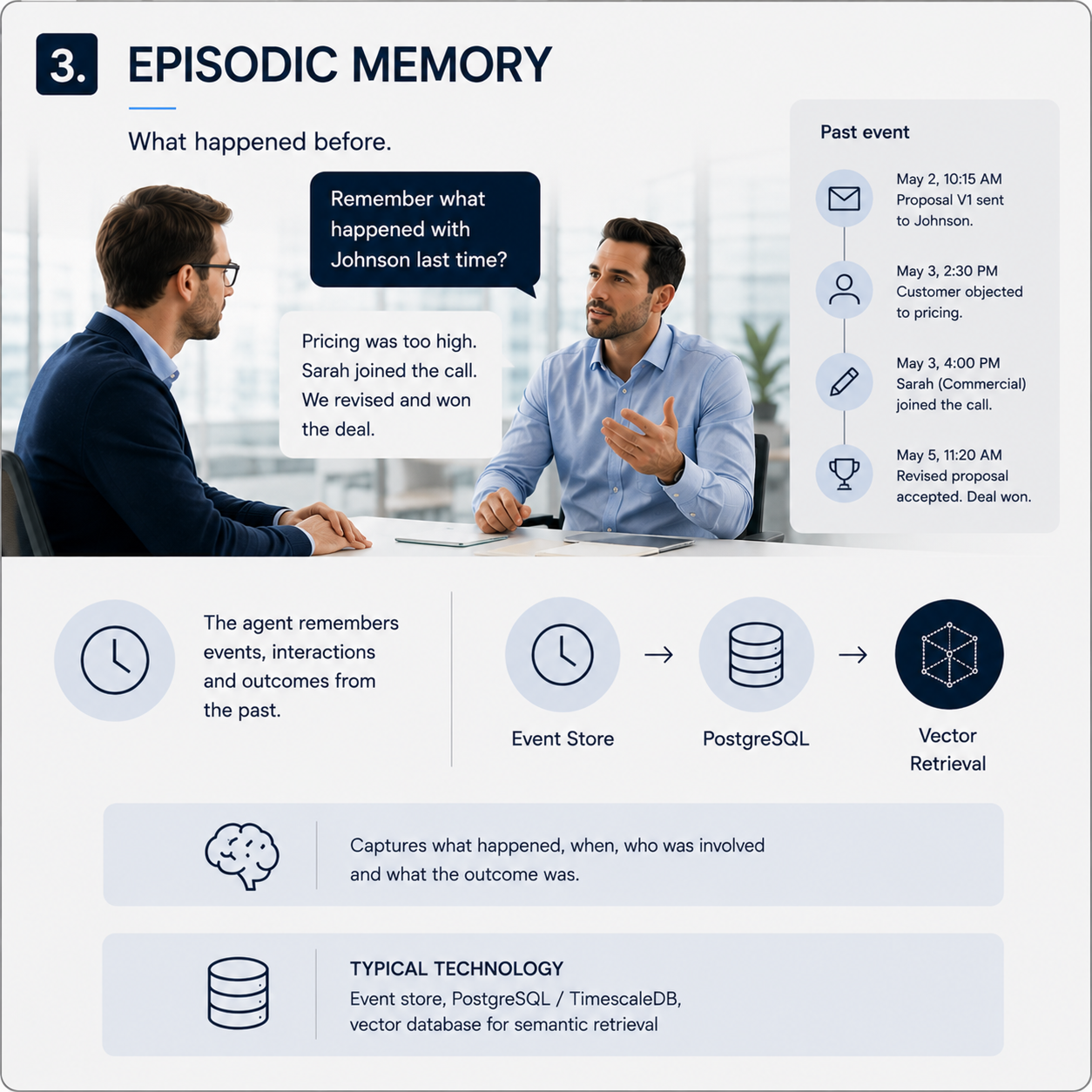
There is another kind of memory.
The manager asks, “Remember what happened with Johnson last time?”
The colleague remembers that the original pricing was too high, the customer pushed back, Sarah joined the call, the proposal was revised and the team eventually won the deal.
This is different from simply knowing that Johnson is price sensitive.
It is a memory of what actually happened.
That is episodic memory.
For an AI agent, episodic memory captures previous conversations, interactions, decisions, actions and their outcomes. Over time, this allows an agent to retrieve relevant experiences rather than only static information.
A company might store these events in PostgreSQL, TimescaleDB or a dedicated event store. Important episodes can also be embedded into a vector database, allowing the agent to retrieve previous situations that are semantically similar to the one it is dealing with now.
This distinction between semantic and episodic memory is important.
Semantic memory might tell the agent that Johnson is price sensitive. Episodic memory tells the agent why it knows that.
That begins to give AI something closer to organisational experience.
4. Procedural Memory
How we do things
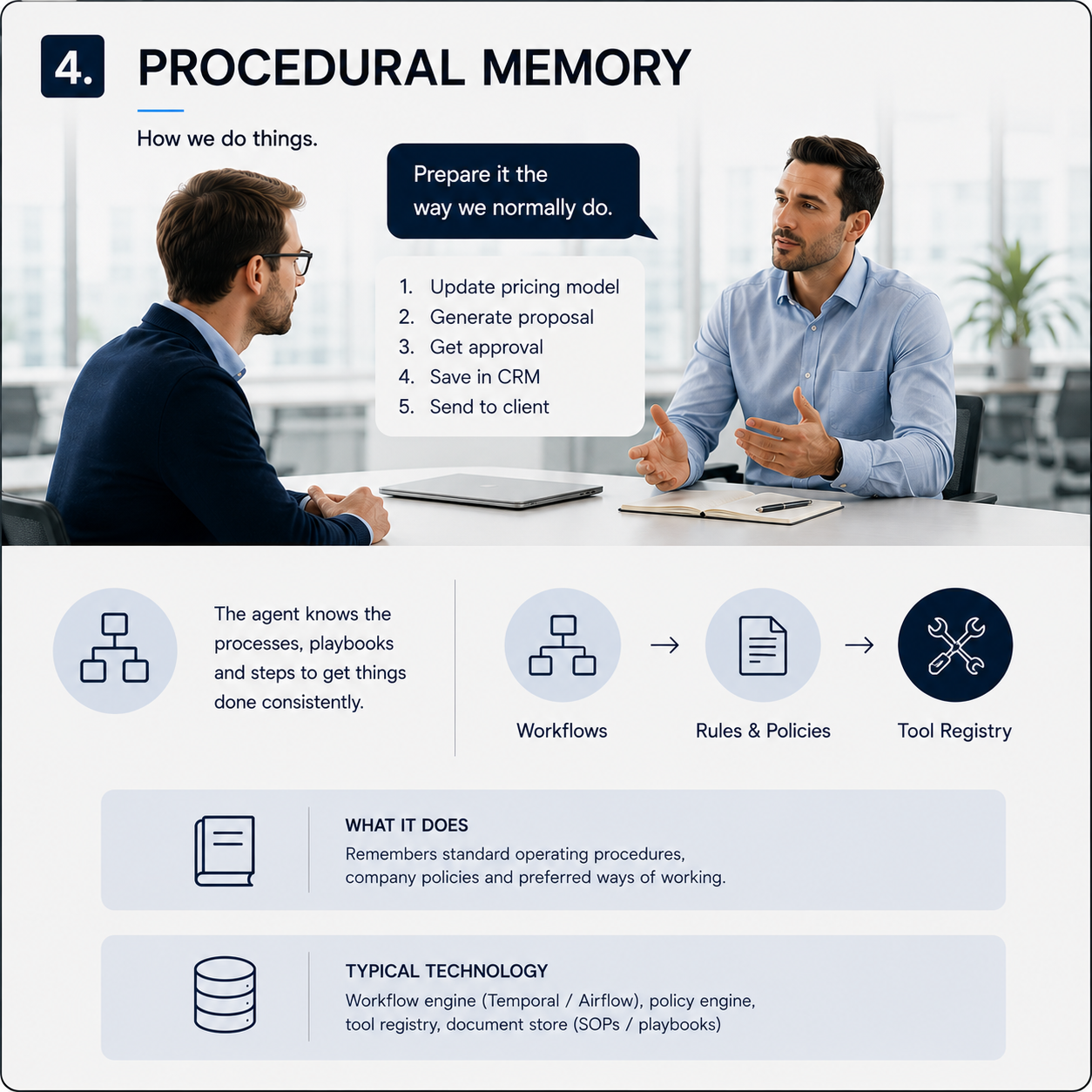
The manager then says, “Prepare it the way we normally do.”
An experienced colleague understands what that means.
They update the pricing model, generate the proposal, obtain the required approval, save the final version in the CRM and send it to the client.
Nobody needs to explain the entire process every time.
That is procedural memory.
For an AI agent, procedural memory represents the processes, playbooks, policies and preferred ways an organisation gets things done.
Technically, this may be implemented using workflow engines such as Temporal or Airflow, application logic, policy engines, tool registries and document stores containing standard operating procedures.
This also illustrates an important principle in agent architecture.
Not every form of memory belongs in a vector database.
If something is a deterministic business process, it may be safer and more reliable to represent it as an explicit workflow or business rule. The AI can reason about what needs to happen while the underlying software ensures that important processes are followed correctly.
5. Parametric Memory
What the model already knows
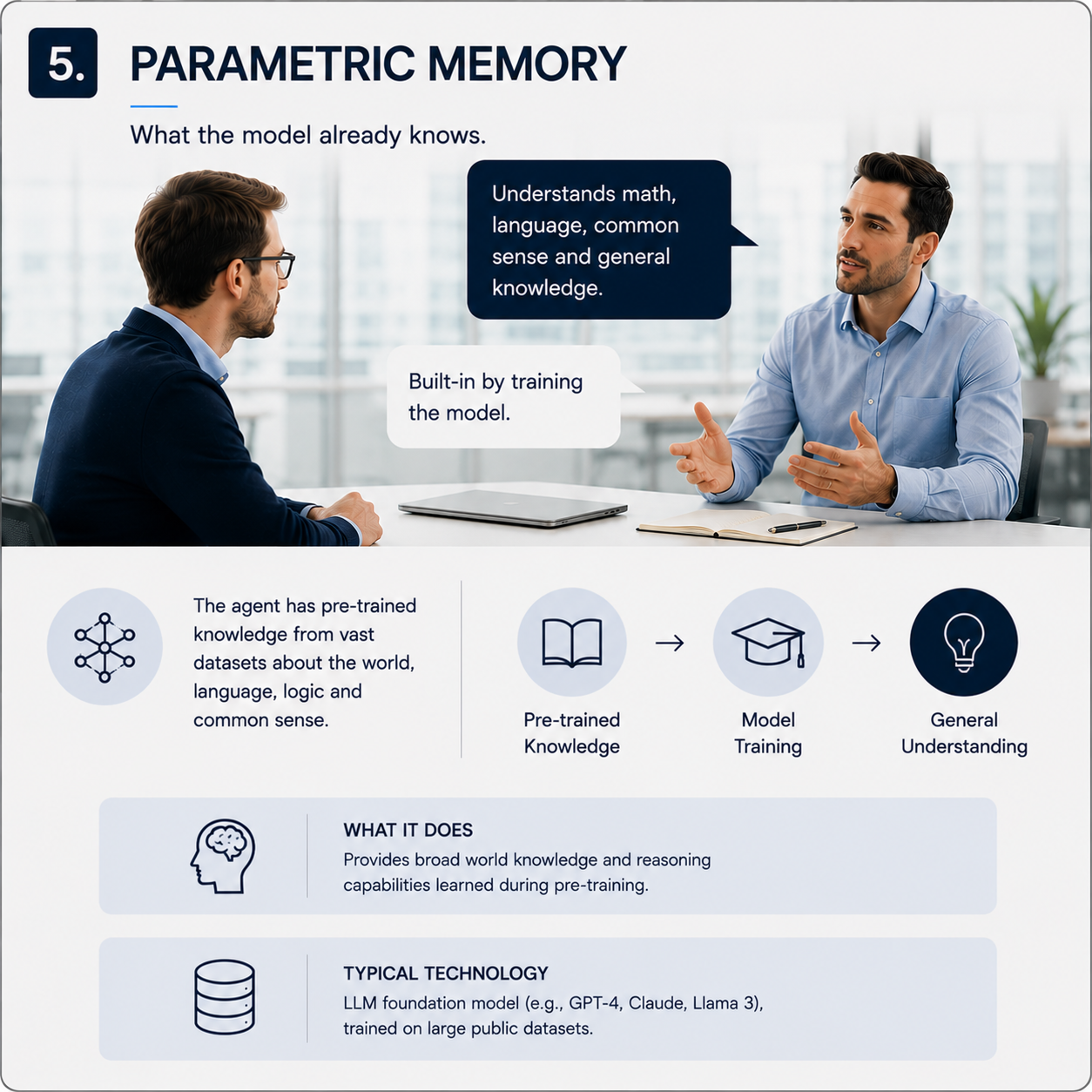
Your colleague already understands what percentages are. They understand how professional emails are written. They know what concepts such as margin, revenue, contracts and negotiation mean.
Nobody in your organisation had to teach them these things during today’s conversation.
AI models have something similar.
This is parametric memory, the knowledge encoded into the model itself during training.
Foundation models arrive with enormous amounts of general knowledge about language, concepts, reasoning patterns and the world before they ever interact with your organisation.
This makes parametric memory extremely powerful, but it has an important limitation.
It should not become the database for your company.
If Sarah becomes CEO tomorrow, you should not need to retrain an AI model for it to understand her new role. Changing organisational information belongs in external memory systems where it can be updated immediately.
Parametric memory provides the general intelligence. The other memory systems provide the organisational context around it.
6. Prospective Memory
What we need to remember to do
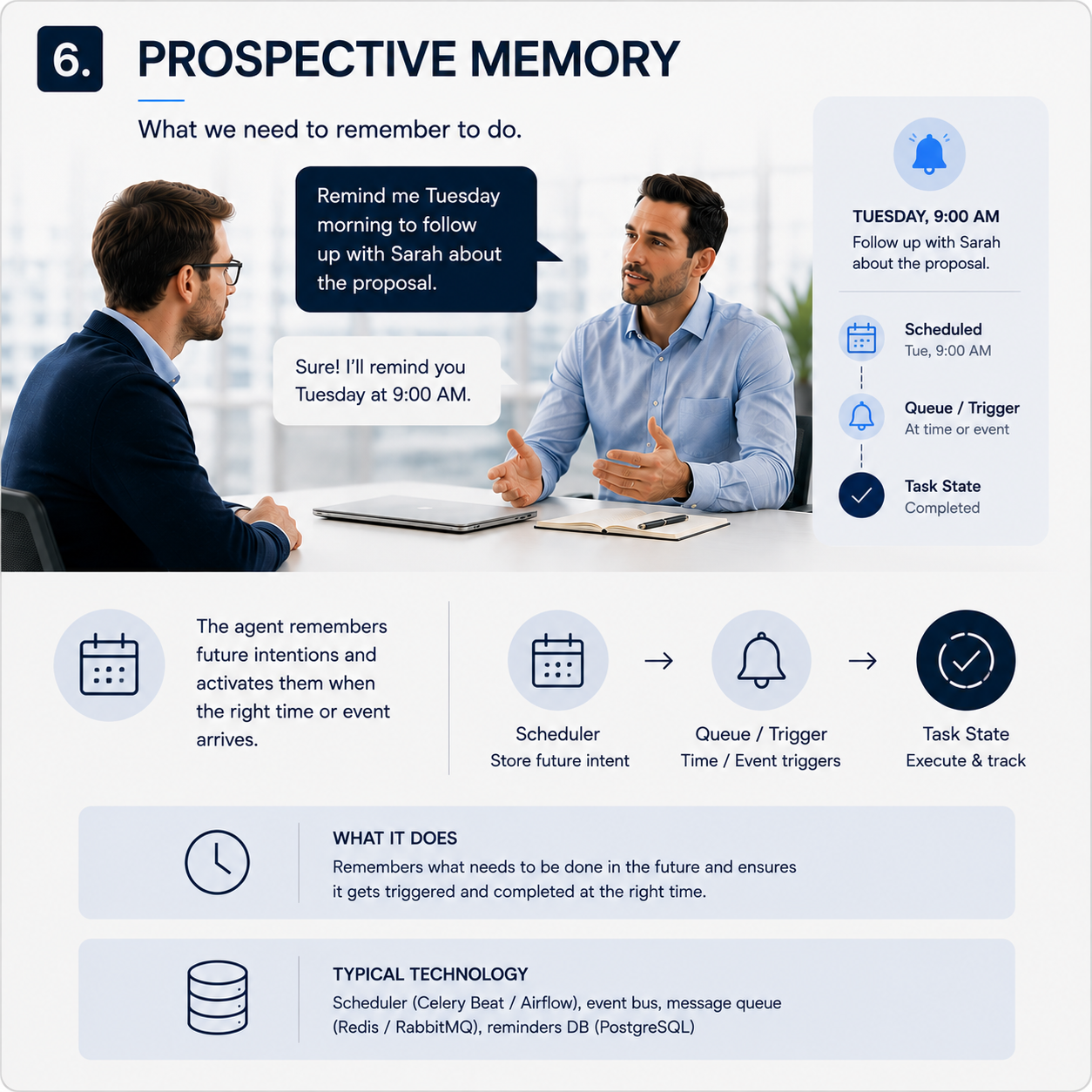
Finally, the manager says, “Remind me Tuesday morning to follow up with Sarah.”
The conversation finishes, everyone gets on with their day, and Tuesday has not happened yet.
But the responsibility still exists.
That is prospective memory.
Unlike episodic memory, which remembers what happened in the past, prospective memory remembers what needs to happen in the future.
This becomes increasingly important as AI moves from answering questions to performing work autonomously across hours, days or even weeks.
An agent might remember that a proposal requires approval, that Sarah is responsible for approving it, that the manager wants to be notified on Tuesday morning if approval has not happened, and that the task should disappear once the approval is received.
Technically, this requires persistent task state combined with schedulers, event systems, queues or workflow engines. Technologies such as Celery, Airflow, Redis, RabbitMQ or PostgreSQL might form part of the implementation depending on the scale and complexity of the system.
The important point is that the agent can stop operating today and still know what it needs to do tomorrow.
Putting the Six Memories Together
The interesting part is not any individual memory system. It is what happens when they work together.
Consider the manager’s original instruction again:
“Change Johnson’s proposal to 15%, prepare it the way we normally do and remind me Tuesday if Sarah hasn’t approved it.”
Working memory allows the agent to understand what “it” refers to.
Semantic memory tells it who Johnson and Sarah are and provides the relevant facts about the account.
Episodic memory allows it to understand what happened during the previous negotiation and why the proposal is being changed.
Procedural memory tells it how proposals are normally prepared, approved and sent.
Parametric memory provides the underlying understanding of language, pricing, business concepts and reasoning required to interpret the instruction.
Prospective memory ensures that the Tuesday follow-up actually happens.
Behind the scenes, these capabilities can draw from the systems a company already uses. Customer information may come from a CRM. Conversations may come from email or meeting transcripts. Documents may contain policies and contracts. ERP systems may provide operational information. Databases may contain structured company data.
A memory layer allows the agent to determine which parts of that organisational context matter for the task at hand. A retrieval system then brings the relevant information into the agent’s current context. The language model provides the reasoning capability, while workflows and business systems allow the agent to take actions.
The result might be a decision, an updated record, a generated document, a follow-up scheduled for later or an escalation to a human when judgment is required.
The architecture does not need to make every piece of organisational information available to the model at once.
In fact, it should not.
The real intelligence comes from giving the agent the right context, from the right memory, at the right time.
From AI Assistants to AI Colleagues
For the last few years, much of enterprise AI has focused on answering questions.
Connect an LLM to company documents. Add retrieval. Put a chat interface in front of it.
Useful, but limited.
The next generation of enterprise AI systems will need something more important: continuity.
They need to understand what is happening now, what the organisation knows, what happened before, how work gets done and what needs to happen next.
That is when an AI system begins to feel less like a search box and more like a colleague.
At Dutch Technology Frontiers, this is the kind of problem we help organisations solve.
We work with companies to identify where agentic AI can create meaningful operational leverage, then design and build the architecture behind it. That includes connecting organisational data, memory, workflows, AI models and existing software into systems that can actually participate in work.
Because building an AI agent is not simply about giving an LLM more intelligence.
It is about giving that intelligence context, continuity and memory.