
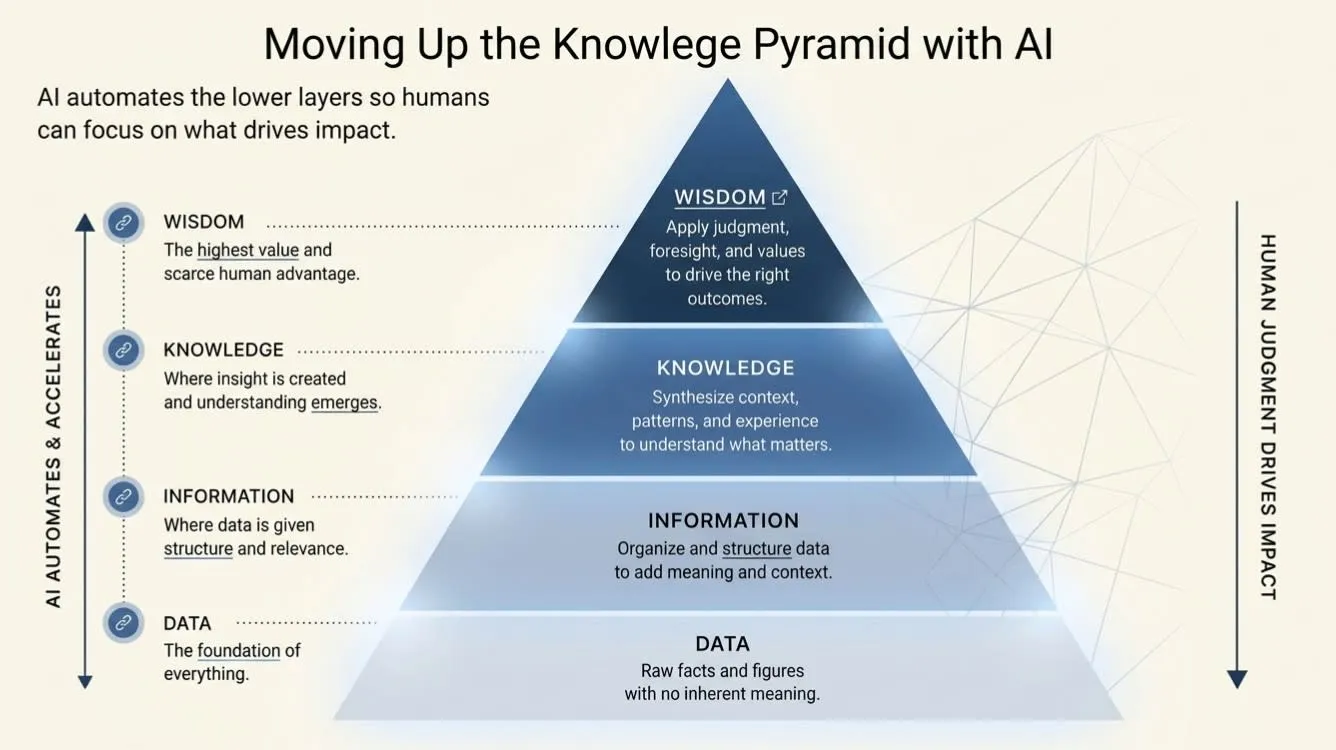
For decades, technology has been climbing the DIKW Pyramid: from the computer revolution’s fixation on gathering data, through the rise of data science that turned raw numbers into structured information, to today’s frontier: the Knowledge layer.
Generative and agentic AI are changing how organizations synthesize context, identify patterns, and create knowledge from enormous volumes of information. The argument is straightforward: machines are increasingly capable of operating at the Knowledge layer, which means humans can spend more of their time where they are most valuable, at the Wisdom layer, applying judgment, experience, and strategic thinking rather than processing information.
This shift matters across knowledge-intensive industries.
Whether you work in legal services, recruitment, finance, consulting, or another information-heavy profession, success increasingly depends not on how much data you have, but on how quickly you can turn that data into understanding, and understanding into action.
The paradox is that the world has never produced more data, yet organizations remain starved for the judgment required to make sense of it.
1. The Data Era: Building the Foundation
Over the past three decades, technology relentlessly expanded the base of the pyramid.
Industries poured billions into collecting and digitizing the world: CRMs to record every client interaction, ERP systems to capture every transaction, document management systems to preserve institutional records, IoT sensors to measure physical environments, and smartphones and digital platforms to capture almost every form of human activity.
The logic was simple: more data means more truth.
And so the Data Era was defined by instrumentation: gathering, storing, and structuring.
But organizations soon discovered the limitation. Data without context is noise. A database containing millions of records is only valuable if someone, or something, can determine what those records actually mean.
Eventually, almost every organization had more data than its people could reasonably process.
2. The Information Era: Making Sense of Data
As databases scaled beyond any human ability to read them, a new problem emerged: how do we connect the dots?
This gave rise to the Information layer, where raw data becomes structured, categorized, and meaningful.
Through the 2000s and 2010s, organizations increasingly applied statistical and algorithmic methods to uncover patterns, relationships, and signals. Data science, machine learning, business intelligence, and predictive analytics became serious disciplines.
Information, in essence, is data plus relationships: the who, what, when, and where.
Across industries, this produced increasingly sophisticated tools.
Financial institutions built risk models and forecasting systems. Recruitment firms developed candidate scoring, matching, and workforce analytics. Legal teams gained powerful document search and e-discovery platforms. Businesses of every kind built dashboards designed to turn millions of records into something a human could actually interpret.
These systems brought people closer to insight.
But there was still a ceiling.
Traditional software could organize information, calculate relationships, and identify patterns. What it struggled to do was understand those patterns within a broader context, to read across documents, interpret language, reconcile conflicting evidence, understand intent, and construct a coherent narrative.
Those are the ingredients of knowledge.
3. The Knowledge Era: Generative and Agentic AI
The 2020s changed the game.
For the first time, technology is beginning to operate meaningfully at the Knowledge layer of the pyramid, powered by large language models and increasingly sophisticated agentic AI systems.
Modern AI systems do more than retrieve information. They can reason across structured and unstructured data, understand context, compare evidence, identify inconsistencies, and synthesize large volumes of information into usable knowledge.
That represents a fundamental shift: the automation of contextual understanding itself.
Consider the workflows that occupy highly skilled professionals today.
A lawyer may spend hours reading contracts, correspondence, precedents, and case files before forming an opinion.
A recruiter may work across hundreds of CVs, interview notes, job requirements, candidate communications, and CRM records before deciding who deserves attention.
A financial analyst may reconcile spreadsheets, management reports, contracts, market information, and historical performance before arriving at a view of a business.
These are different professions, but computationally they share a remarkably similar problem:
Large amounts of fragmented information must be transformed into context before a human can make a decision.
Generative AI dramatically reduces the cost of that transformation.
And agentic AI takes the capability further.
Instead of simply responding to a question, AI agents can work through multi-step processes: retrieving information, comparing sources, checking assumptions, identifying missing data, applying organizational rules, and producing outputs in the formats a particular team already uses.
The human in the loop is not necessarily being replaced.
The human is being elevated.
4. Humans Reclaim the Wisdom Layer
If machines can increasingly handle data gathering, information processing, and knowledge creation, humans can spend more time doing what we are uniquely equipped to do: applying experience, exercising judgment, understanding nuance, and making decisions under uncertainty.
In legal work, that means less time searching and summarizing documents, and more time developing arguments, advising clients, negotiating, and determining strategy.
In recruitment, it means less time manually screening candidates and reconciling systems, and more time understanding people, assessing potential, building relationships, and making difficult hiring decisions.
In finance, it means less time assembling reports and reconciling numbers, and more time interpreting risk, challenging assumptions, allocating capital, and deciding what should happen next.
The progression looks like this:
Collecting data → connecting data → creating knowledge → applying wisdom.
For decades, humans have worked across every level of that chain.
Increasingly, machines can handle the first three.
That final step, wisdom, is where human judgment becomes the real value driver.
5. Where Dutch Technology Frontiers Comes In
At Dutch Technology Frontiers, we work with organizations to make that transition practical.
We build AI systems around the workflows where skilled professionals still spend enormous amounts of time gathering information, reconciling sources, interpreting documents, and producing repetitive outputs.
That might mean transforming large collections of contracts and correspondence into structured legal knowledge. It might mean orchestrating candidate information and recruitment workflows across hundreds of recruiters. Or it might mean bringing together financial documents, operational reports, and external information to continuously surface risks and insights.
The technology changes from one industry to another.
The underlying problem often does not.
Critical organizational knowledge is fragmented across documents, databases, emails, systems, and people, and highly skilled professionals spend too much of their time manually assembling that context before they can actually use their expertise.
Our approach is therefore not about adding another generic AI interface on top of an organization.
It is about embedding AI into the workflows, systems, artifacts, and decision processes that already exist, and designing systems that understand how that particular organization works.
The goal is straightforward:
Your people should spend less time constructing knowledge and more time applying judgment to it.
AI handles more of the pyramid’s lower floors.
Your team works closer to the top.
6. The Road Ahead
The DIKW Pyramid is no longer simply a classroom model. It is becoming a useful roadmap for understanding where technology is headed, and where competitive advantage may increasingly be created.
Over the past three decades, the base of the pyramid expanded dramatically through digitalization.
We instrumented businesses. We digitized documents. We built databases. We connected systems. We created dashboards and analytics platforms to help humans navigate the resulting explosion of information.
Now, for the first time, technology is beginning to climb another level.
The next generation of software will not simply store information or help us find it. It will increasingly read, interpret, connect, reason, and act upon it.
That changes the economics of knowledge work.
Organizations that successfully make this transition will not necessarily be the ones with the most data, the largest teams, or even the most sophisticated AI models.
They will be the ones that redesign how humans and machines divide the work.
Machines will increasingly collect the data, connect the information, and construct the knowledge.
Humans will decide what it means, what matters, and what to do next.
That is the Wisdom layer.
And that is where the human advantage increasingly begins.

15+ years across digital twin simulation, defence, banking, SaaS and e-commerce, from flight dynamics at Lockheed Martin to building and scaling engineering at Carbon6 through its $210M acquisition. He has led technology due diligence on transactions above $100M.
Hashim on LinkedIn