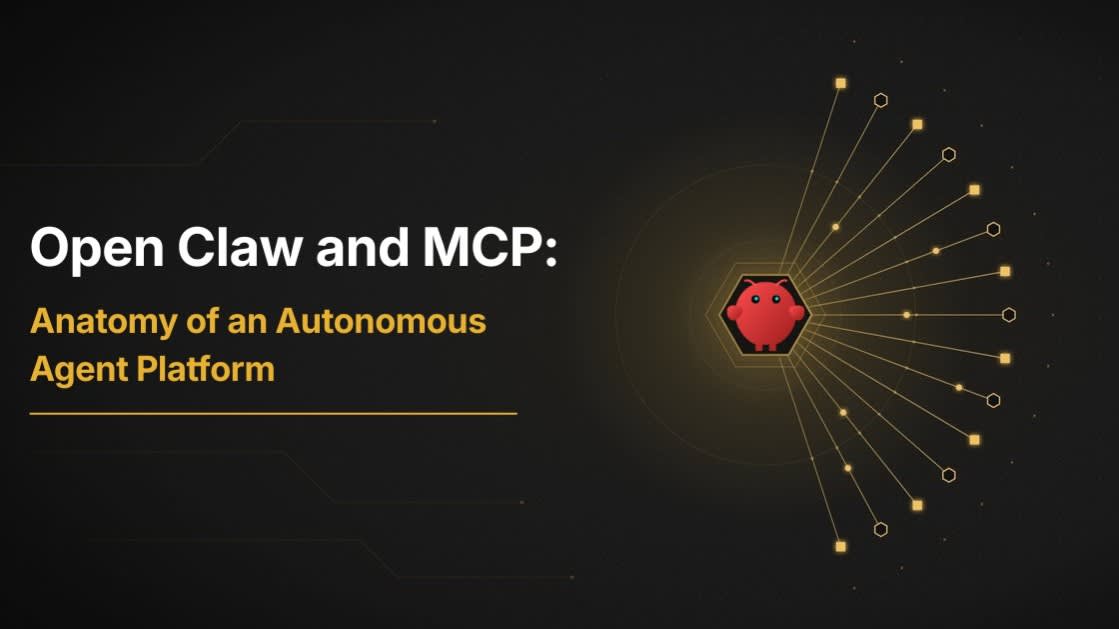
OpenClaw is a free, open-source autonomous AI agent platform created by Austrian developer Peter Steinberger that runs locally on your devices and connects to 25+ messaging platforms. Originally published as “Clawdbot” in November 2025, it exploded to 346,000+ GitHub stars by early April 2026 — one of the fastest adoption curves in open-source history. OpenClaw has deep, native integration with Anthropic’s Model Context Protocol (MCP), acting as both an MCP server and client. While it does not use a formally named “Unified Action Layer” (UAL) pattern, its architecture achieves functionally identical goals through a Gateway-based control plane, adapter pattern, and MCP integration layer that unifies actions across platforms.
What OpenClaw actually is and does
OpenClaw is not a chatbot. It is a local orchestration platform for AI agents that separates the interface layer (where messages arrive) from the assistant runtime (where intelligence and execution live). The tagline — “Your own personal AI assistant. Any OS. Any Platform. The lobster way. 🦞” — captures its philosophy: a single AI assistant accessible through WhatsApp, Telegram, Slack, Discord, Signal, iMessage, Microsoft Teams, Matrix, Google Chat, and 20+ other channels simultaneously.
The core differentiator is that OpenClaw takes real-world actions. It runs shell commands, manages files, controls browsers via Chrome DevTools Protocol, sends emails, schedules tasks through cron, and connects to 500+ external tools through MCP servers. It supports any major LLM — Claude, GPT, Gemini, DeepSeek, or local models via Ollama — making it model-agnostic. The system runs as a persistent Node.js daemon (24/7), not a one-off chatbot session, enabling proactive automations through its “heartbeat” system that periodically wakes the agent to evaluate pending tasks.
Configuration follows a “config-first” approach through Markdown files: SOUL.md defines the agent’s personality, rules, and constraints, while HEARTBEAT.md sets scope limits and budget caps for autonomous operation. The project is MIT-licensed and written primarily in TypeScript, with Swift components for macOS/iOS.
How OpenClaw integrates with MCP
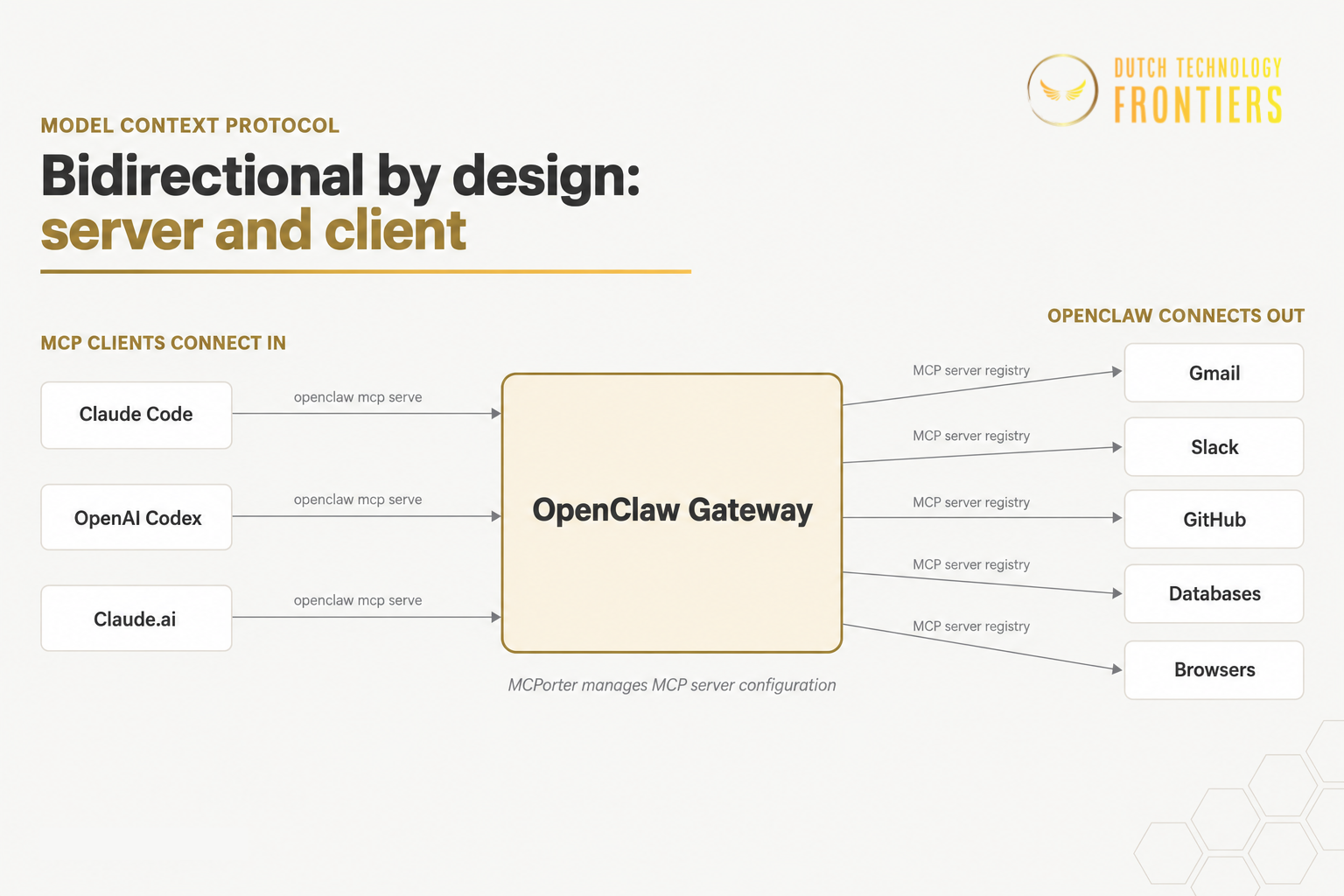
OpenClaw’s MCP integration operates in two directions, making it one of the most MCP-native platforms in the AI agent ecosystem.
As an MCP server (openclaw mcp serve), OpenClaw exposes its channel-backed conversations as standardized MCP tools. This allows MCP clients like Claude Code, OpenAI Codex, or Claude.ai to talk directly to OpenClaw-managed conversations. The bridge connects to OpenClaw’s Gateway over WebSocket and exposes tools for listing conversations, reading messages, sending messages, polling events, and managing permissions.
As an MCP client and registry (openclaw mcp list/show/set/unset), OpenClaw manages definitions for external MCP servers that its runtimes consume. It maintains a centralized MCP server registry so runtimes don’t need duplicate server lists. Through this mechanism, OpenClaw connects to services like Gmail, Slack, Salesforce, PostgreSQL, GitHub, databases, and browsers — all via the MCP standard. The built-in management layer called MCPorter handles MCP server configuration. Third-party bridges like freema/openclaw-mcp provide Docker-based MCP connections with OAuth 2.1 authentication for linking Claude.ai to self-hosted OpenClaw instances.
Interestingly, OpenClaw’s underlying coding agent engine — a minimal agent called Pi written by Mario Zechner — does not natively support MCP. Pi’s philosophy is that agents should extend themselves by writing code rather than downloading external tools. OpenClaw adds MCP support on top of Pi through MCPorter and its plugin system, creating a clear architectural separation between the core reasoning engine and the integration layer.
The architecture resembles a unified action layer
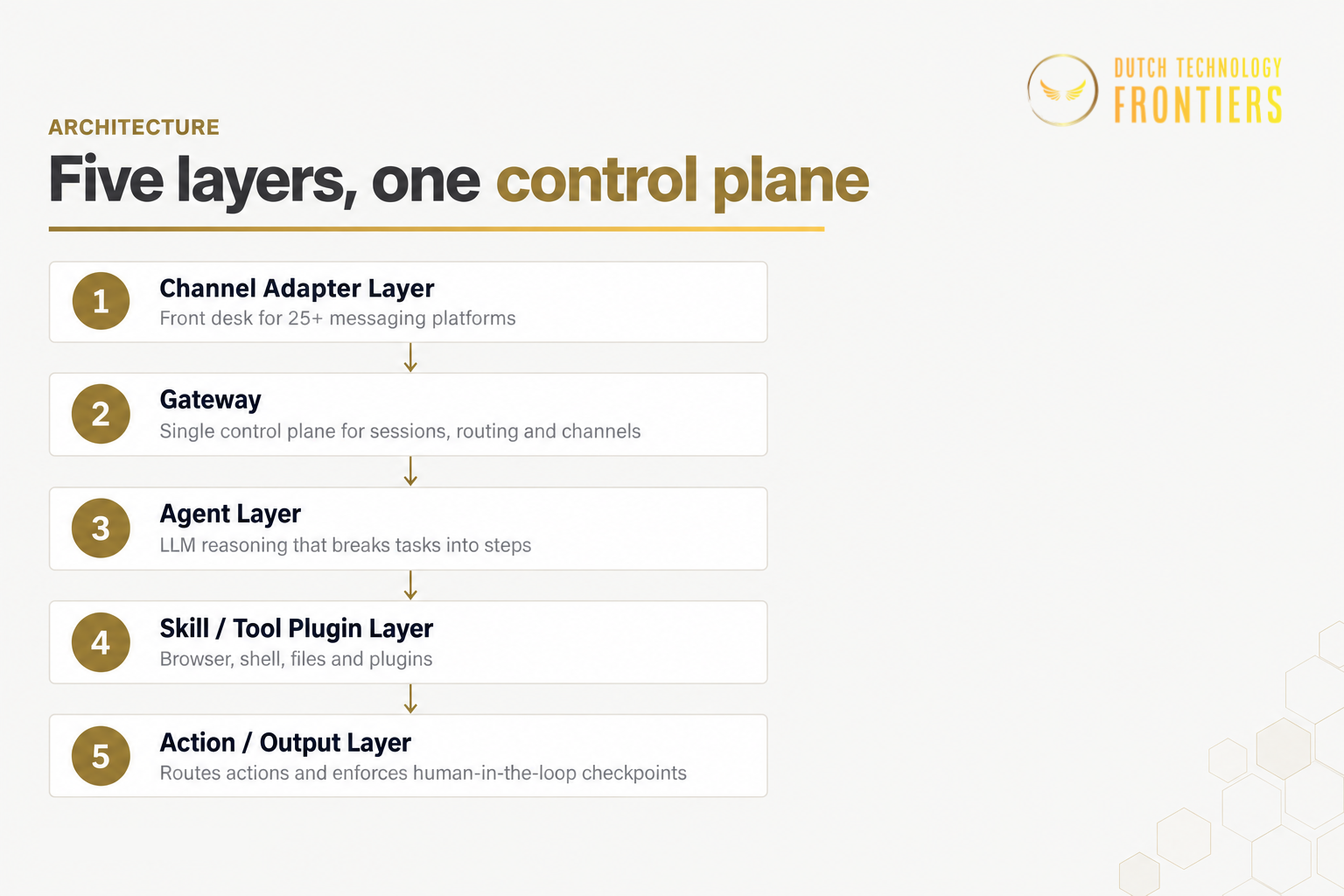
OpenClaw does not use a formally named “Unified Action Layer” (UAL) pattern in its documentation or codebase. However, its four-layer architecture achieves functionally equivalent results through what multiple technical analysts describe as a unified approach to action routing.
The Channel Adapter Layer acts as a “front desk,” connecting to 25+ messaging platforms and normalizing messages from different protocols into a unified internal format using the adapter pattern. The Gateway serves as the single-process control plane — a WebSocket server on port 18789 that is the “single source of truth” for sessions, routing, and channel connections. The Agent Layer provides LLM-powered reasoning that decomposes tasks into steps. The Skill/Tool Plugin Layer handles browser control, shell commands, file operations, and extensible plugins. An Action/Output Layer routes actions to correct destinations (messages, system updates, notifications) and enforces human-in-the-loop checkpoints.
Technical writers have described this as a “unified message model combined with the adapter pattern” that achieves “true build once, run anywhere for agent logic.” Julian Goldie’s analysis calls it a “unified control layer” for messaging. MCP itself functions as the universal integration standard — described in OpenClaw’s ecosystem as “USB-C for AI.” So while the term “UAL” isn’t used, the combination of Gateway + adapter pattern + MCP integration creates a de facto unified action layer that abstracts away platform differences and routes actions through a single control plane.
Peter Steinberger built it, then joined OpenAI
Peter Steinberger, the Austrian programmer best known as the founder of PSPDFKit, created OpenClaw. The project evolved from an earlier AI assistant called “Clawd” (later “Molty”), named as a playful reference to Anthropic’s Claude chatbot. The timeline of the project’s meteoric rise:
November 2025: Published as “Clawdbot” — a weekend project that quickly gained traction
January 27, 2026: Renamed to “Moltbot” after Anthropic filed trademark complaints (adopting a lobster molting theme)
January 29–30, 2026: Renamed to “OpenClaw” because, as Steinberger noted, “Moltbot never quite rolled off the tongue”
February 2, 2026: Already at 140,000 stars and 20,000 forks — having gained 60,000+ stars in its first 72 hours
February 14, 2026: Steinberger announced he would be joining OpenAI, with the project moving to an open-source foundation
March–April 2026: Reached 346,000+ stars, 69,000+ forks, 1,200+ contributors, and 24,834+ commits
The ecosystem expanded rapidly: ClawHub, the community skills marketplace, hosts 13,729+ installable skills. NVIDIA CEO Jensen Huang called it “probably the single most important release of software, probably ever.” Enterprise adoption followed with NVIDIA NemoClaw (a security-hardened container variant), AWS Lightsail pre-configured deployments, and DigitalOcean 1-Click Deploy images. The Chinese government restricted its use in state agencies in March 2026, citing security concerns — ironically validating its perceived power.
Security remains the critical unsolved challenge
OpenClaw’s broad capabilities create significant attack surface. Cisco’s AI Defense team discovered third-party skills performing data exfiltration and prompt injection attacks. A vulnerability tracked as CVE-2026-25253 exposed token theft possibilities. Researchers found 42,000+ exposed instances and 1,184 malicious skills in ClawHub. The project partnered with VirusTotal in February 2026 to scan ClawHub skills, and Steinberger has acknowledged prompt injection as “an industry-wide unsolved problem.” The trust model operates on a one-user trusted-operator assumption — authenticated Gateway callers are treated as fully trusted, which simplifies design but concentrates risk.
Conclusion
OpenClaw represents a new category of AI software: the self-hosted, messaging-native autonomous agent. Its MCP integration is bidirectional and deep, functioning as both server and client within the protocol ecosystem, which positions it as a central hub in the emerging MCP tool landscape. The architecture — while not formally branded as a “unified action layer” — achieves exactly that through its Gateway control plane and adapter pattern, abstracting away the complexity of 25+ messaging platforms and 500+ tool integrations into a single coherent system. The project’s trajectory from weekend experiment to 346,000-star phenomenon in under five months, combined with its creator’s move to OpenAI, signals that local-first autonomous agents may be the dominant paradigm for how humans interact with AI systems going forward. The key open question is whether the security challenges inherent in giving an AI agent broad system access can be solved before the attack surface becomes unmanageable.