“The AI keeps getting it wrong.”
If your team builds with AI coding tools, you've heard this sentence, in a retro, in a code review, or in your own head while reading a timeline that slipped again. Most teams respond by blaming the model, switching tools, or writing longer and longer instruction files. In my experience, the real cause is usually none of those. It's how the agent's memory is organized, and that, it turns out, is a product decision as much as an engineering one.
I lead product, working every day with a dev team. My side of the build is users, specs, clients, and the timeline. So when I say the most important AI decision on our project wasn't which tool to buy but how we structured what the agent knows, that's a delivery opinion, formed by being accountable for what ships and when.
The mental model: permanent memory vs. specialists on call
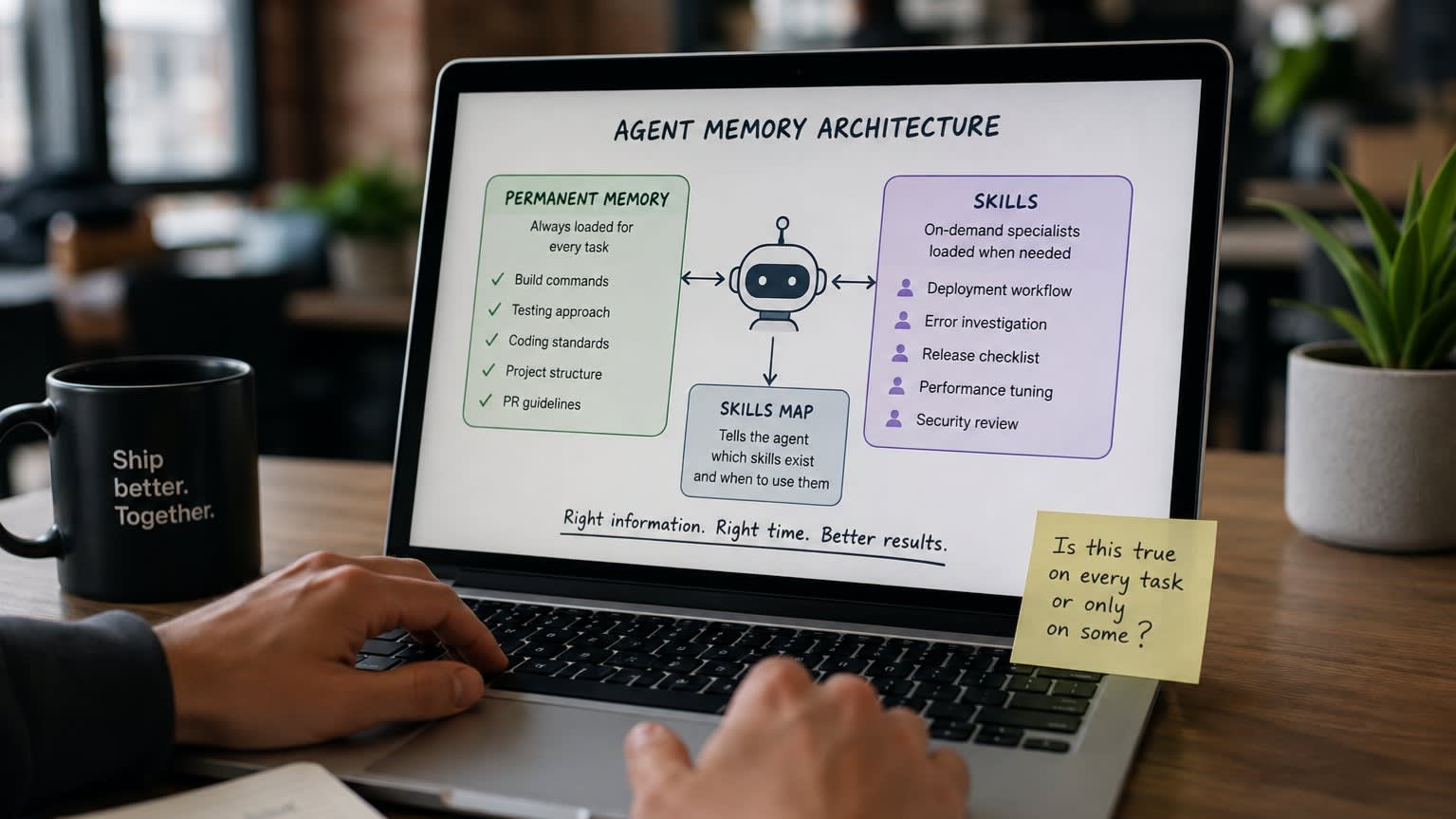
Working alongside the team in Cursor, here's the distinction that changed everything for us. The AGENTS.md file is the agent's permanent memory of the repository, read on every task, no exceptions. Skills are specialists called in only when the task needs them.
That one distinction decides how everything the agent knows gets split.
Into permanent memory goes only what applies to every single task: build commands, how tests run, coding style, project structure, how PRs are formatted. There should be surprisingly little of it.
Everything situational lives in skills, separate SKILL.md files the agent pulls only when relevant: the deployment workflow, the error-investigation procedure, the release checklist. In permanent memory, these would be dead weight, crowding the context on tasks that never touch them, which is exactly how agents start “getting it wrong.”
One step ties it together, and it's the one most setups miss: mapping the skills inside AGENTS.md, a short index telling the agent which specialists exist and when to call them. Without the map, the skills are a library nobody visits.
What this buys you, in product currency
An agent with clean memory architecture behaves consistently, and consistency is the currency of anyone accountable for delivery. When the agent follows the same conventions on every task, estimates hold. Reviews surface fewer surprises. Features touching old parts of the product don't quietly break standards set months ago. On our project, this is part of why the gap between “the client raised this on Monday” and “the client saw it working on Friday” keeps shrinking. Even our Jira is connected to the agent through MCP, so I can check where we stand against the timeline without pulling an engineer out of focus.
And every “the AI keeps getting it wrong” I've traced had the same root: one bloated instruction file doing the job of ten small ones, drowning the agent in rules irrelevant to the task in front of it. That's not a model problem. It's an organization problem, and organizing information is something product people do for a living.
The one question that structures everything
Tutorials on setting this up are everywhere, so I'll leave you with the reasoning instead. Ask of every instruction you want your agent to have: is this true on every task, or only on some? Every-task instructions go in permanent memory, and keep that ruthlessly small. Some-task instructions become skills, one file, one job. Then connect the two with a map.
You don't need to write code to have a stake in this. If you're accountable for what ships and when, the structure of your agent's memory is already your business. Bring this question to your next team discussion and see what your AGENTS.md looks like today. The answer is usually revealing.