
Three minutes into the demo, I realized I was doing too much explaining.
We were showing the dialer to a client for an applicant tracking system my team is building. Engineering and I had put the first version together. It had a lot of buttons. Every feature was there, everything discoverable. It felt clean to us because we knew where everything was. Sitting in that meeting, watching myself narrate what was supposed to be obvious, the lesson landed: a thing feels intuitive to the people who built it because they built it, not because it is.
The reframe was simple. A dialer should feel like dialing a phone. Everyone does that every day. iPhone, Samsung, Aircall. The patterns are already in the user's head. Use them.
I opened Claude, gave it the existing screenshots and that framing, and in a few hours I had the full dialer journey drafted. Click the call button, get the contact on the line, end the call, save the notes. Not a visual mockup, the whole workflow. Without AI, that would have been a week of design iteration, and the first cut wouldn't have been this clean.
Nothing about that story is new PM work. Misjudging, getting feedback, rethinking. A PM in 2005 would have done all of it. The work of product management is making a call when the data is incomplete, and the data is always incomplete. What AI changed is how fast the loop around that call can run.
What AI actually compresses
Fail fast gets repeated until it stops meaning anything. In practice it's concrete: rule out the most wrong answers per week. AI compresses that loop in specific places.
Turning a messy mock into a full workflow takes an afternoon, not a sprint. Pressure-testing your own spec before engineering reviews it takes minutes, not another revision round. Getting from a rough idea to a PRD coherent enough to argue about takes hours, not days.
None of this makes decisions easier. It gets you to the decision faster, and lets you afford more of them.
Why judgment matters more now, not less
AI is good at generating plausible answers. It's not good at knowing which plausible answer is right for your users, your product, and this quarter.
That judgment is the job. And the faster the loop runs, the more it matters. When you can run ten experiments instead of one, the bottleneck moves from doing to choosing. If you can't tell which result matters, you just fail faster in a confused direction.
The PMs getting the most out of AI right now were already good at the unglamorous parts:
Asking sharp questions. Bad questions plus a fast loop produces a lot of confident wrong answers.
Saying no. More options means more chances to chase work the user won't care about.
Holding scope. When AI makes features cheap to build, the bar for saying yes quietly drops. Someone has to hold it up.
The PMs who struggle are usually the ones who were already shaky on the basics. AI doesn't cover that up. It amplifies it.
What AI still can't do
It can't sit in the room when the client stops understanding. It can't tell you that the frustration you're hearing is really about something else. It can't tell you when the data says one thing and your gut says another, and which one to trust.
Those are the moments the job turns on.
So what
If you were a good PM three years ago, you're probably a faster version of the same PM now. If you were struggling, the tools won't save you, and they'll probably expose you.
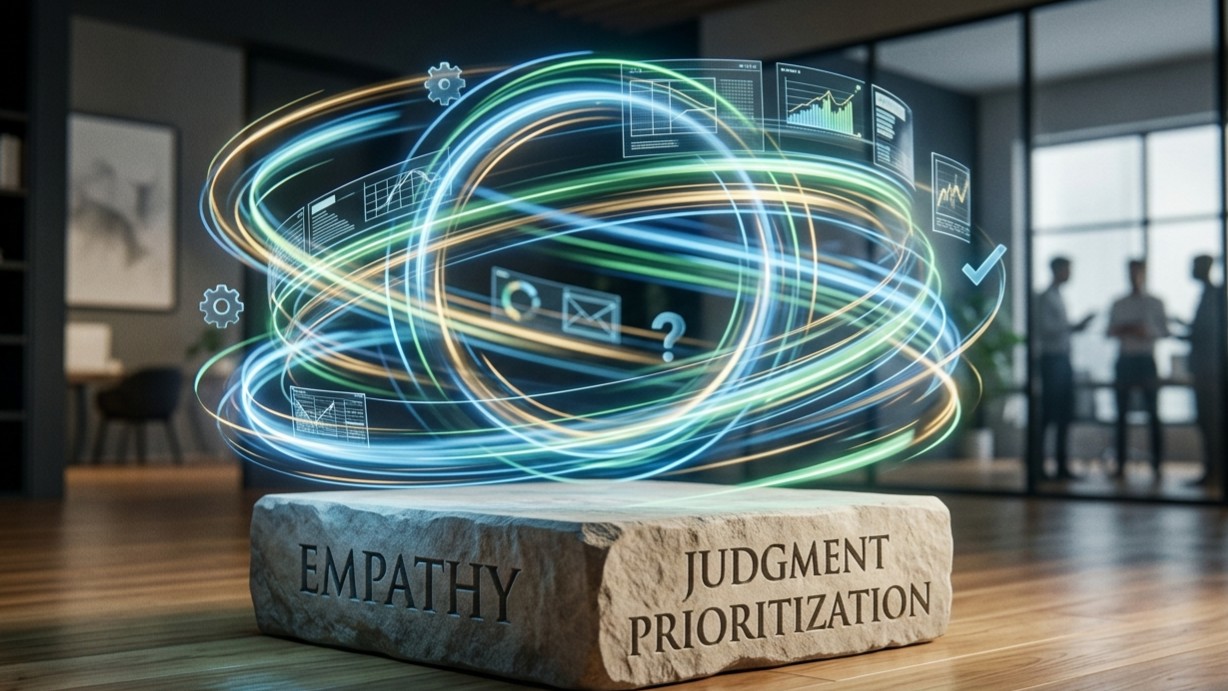
Customer empathy, prioritization, judgment, knowing your triangle. The fundamentals still do the work. AI just lets you run the loop more times before the runway ends.
That's a big deal in the same way a faster compiler is a big deal for engineers. The craft underneath it is still the craft.