
Almost every large company now has an AI policy. Far fewer can tell you which AI agents are running inside the business, what each one is allowed to touch, and who answers for it when something goes wrong.
That gap shows up clearly in recent research. In EY's US AI Risk and Governance Survey, published in September 2026, 98% of the 202 senior AI executives surveyed said their organisation has formal AI governance policies in place. Yet 26% of those whose organisations use agentic AI said they cannot detect unauthorised AI agents operating internally, and 49% said their governance framework hasn't been updated to cover agentic AI at all (EY survey, reported by Dark Reading).
OneTrust's 2026 survey of 1,200 senior decision-makers points the same way. 87% say their organisation encourages employees to use AI agents, but only 47% say that use is backed by clear governance, oversight and controls (OneTrust 2026 AI-Ready Governance Report).
A policy is a document. Governance is knowing what your agents actually do. This post sets out a practical AI agent governance framework a leadership team can put in place in a quarter, without a new department or a new platform.
Why AI agents need their own governance
Most AI governance written before 2025 was designed for models that answer questions. A person reads the answer and decides what to do with it.
Agents are different because they act. They send emails, update records, move tickets, call APIs, trigger payments and hand work to other agents. Two things now matter that didn't before:
What the agent can reach. Singapore's Model AI Governance Framework for Agentic AI calls this the agent's action-space: the tools, systems and data it is allowed to use (IMDA, v1.5, May 2026).
How much it can do without a person. The more steps an agent takes on its own, the more a small mistake can grow before anyone sees it.
An agent can be well built, correctly scoped and still do something expensive while staying inside its permissions. That's why agent governance has to cover what happens at run time, not only what was approved at launch.
The framework: six things every agent needs
Underneath the different standards, a useful AI governance framework for agents comes down to a short list. If you can answer these six for every agent in the business, you have most of what any regulator or auditor will ask for.
1. A register of every agent
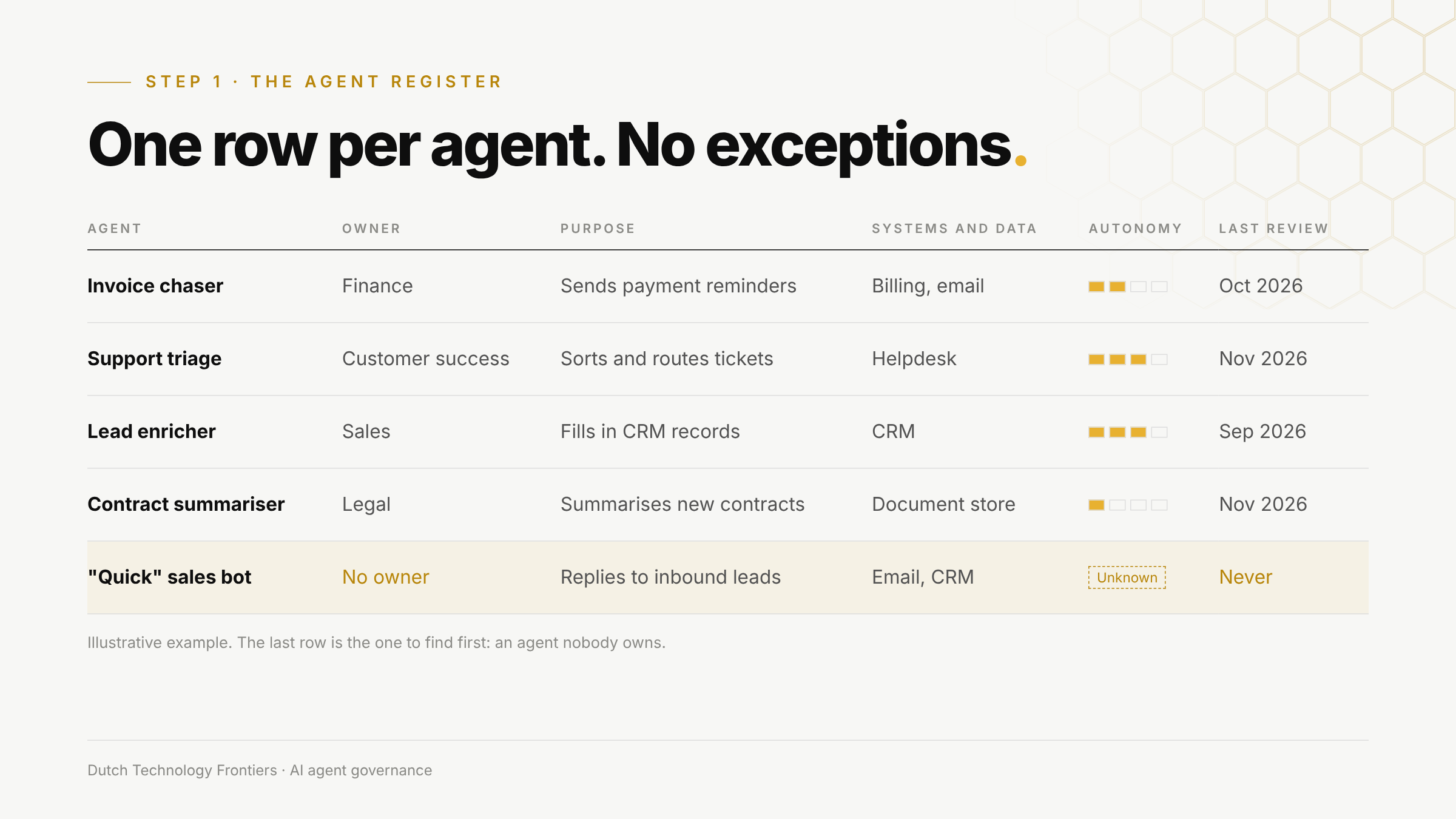
You can't govern what you can't see. Start with a simple register: one row per agent, covering its name, what it's for, which systems and data it touches, its autonomy level, who owns it and when it was last reviewed.
Include the agents built inside SaaS tools, the automations a team set up in an afternoon, and the internal tools built with AI coding assistants. These are usually where shadow AI lives. OneTrust found that one in three organisations had employees using unapproved AI tools because approved options weren't available quickly enough.
Start with the agents that handle customers, money or personal data. That's where the risk is highest.
2. A named human owner
Every agent needs one named person who answers for it. Not a team, not "IT", a person.
The owner approves changes, reviews the logs, decides when the agent's permissions grow, and is the first call when something goes wrong. If nobody is willing to own an agent, that's a strong sign it shouldn't be running.
3. Its own identity and the smallest set of permissions
Agents should never run on a shared human login or a long-lived admin key. Give each agent its own identity, so its actions can be told apart from a person's, and grant it only the access its job needs.
Be specific. "Read the CRM" is a different risk from "update deal values in the CRM", and "draft an email" is different from "send an email to a customer". Write the permissions down in the register, and review them whenever the agent's job changes.
4. A clear autonomy level and approval points
Decide up front how much each agent can do on its own. A simple four-level ladder works for most companies:
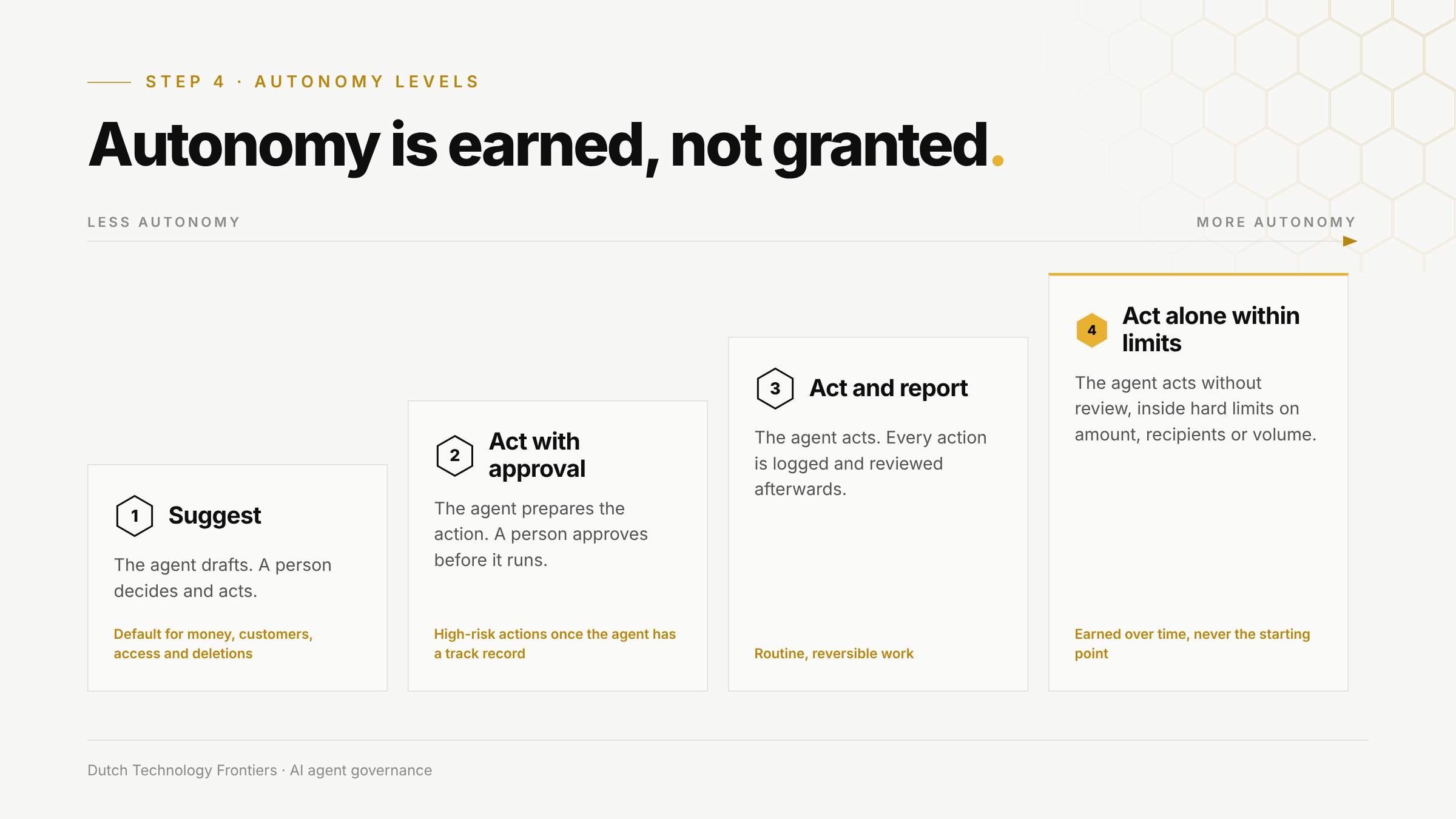
Level 1, suggest: the agent drafts, a person decides and acts.
Level 2, act with approval: the agent prepares the action, a person approves it before it runs.
Level 3, act and report: the agent acts, and every action is logged and reviewed afterwards.
Level 4, act alone within limits: the agent acts without review, inside hard limits on amounts, recipients or volume.
Anything that moves money, contacts customers, changes access rights or deletes data should start at level 1 or 2. Agents earn a higher level with a track record, not by default.
5. Logs, alerts and a way to stop it
For every agent, you should be able to answer three questions quickly: what did it do, why did it do it, and how do we stop it right now?
That means an audit trail of actions and the inputs behind them, alerts when behaviour changes (a spike in volume, a new system touched, a run of errors), and a tested way to pause the agent or revoke its access. A kill switch that has never been tried is a plan, not a control.
6. A review rhythm
Agents change even when nobody touches them. The underlying model gets updated, a connected tool changes its API, or the business process around the agent moves on.
Set a review cadence by risk: monthly for agents at autonomy level 3 or 4, quarterly for the rest. Each review checks the owner is still right, the permissions still fit the job, the logs show nothing unexpected, and the agent still passes its tests.
Where the formal frameworks fit
You don't need to choose between standards before starting. The six steps above line up with the main frameworks a leadership team is likely to hear about:
NIST AI Risk Management Framework: a widely used general framework from the US National Institute of Standards and Technology. The Cloud Security Alliance has published an agentic AI profile that extends it with agent-specific controls.
ISO/IEC 42001: the international standard for an AI management system, useful when customers or partners ask for a certifiable approach.
Singapore's Model AI Governance Framework for Agentic AI: written specifically for agents, first released in January 2026, with a version 1.5 in May 2026. Its focus on action-space and autonomy is practical whatever country you operate in.
The EU AI Act: for companies that operate in or sell into the EU. The AI Omnibus, published in the Official Journal on 24 July 2026, moved the rules for stand-alone high-risk AI systems, such as those used in hiring and employment decisions, to 2 December 2027 (Lewis Silkin, Taylor Wessing). That's extra time, not a reason to wait. A register, named owners and logs are exactly the evidence those rules will ask for.
Who should own AI agent governance
AI agent governance sits between technology, risk and the business, which is why it often falls between chairs. Legal writes the policy, IT manages the tools, and nobody owns the agents a sales team built last month.
It needs a senior technical owner who can make decisions across all three: someone who understands how the agents are built, can say no to a risky permission, and can explain the trade-offs to the board in plain language. In larger companies that's usually the CTO or a head of AI. In growing companies without that role, it's one of the clearest cases for fractional tech leadership: a senior technology leader for a few days a week who sets up the framework, trains the owners and hands over a system the team can run on its own.
A 90-day starting plan
Days 1 to 30: build the register. Find every agent and automation, starting with anything that touches customers, money or personal data. Assign a named owner to each.
Days 31 to 60: set autonomy levels and permissions. Move every agent onto its own identity, cut access to what the job needs, and add approval points for high-risk actions.
Days 61 to 90: add logs, alerts and a tested kill switch for the riskiest agents, then set the review rhythm and put it in the calendar.
By the end, you won't have a perfect system. You'll have something more useful: a clear picture of what your agents do, who answers for each one, and how to stop any of them in minutes.
If you'd like a senior technology leader to set this up with your team, talk to us about fractional tech leadership. And if you're assessing a company that runs AI agents in production, ask how its agents are governed as part of your technology due diligence.
Frequently asked questions
What is AI agent governance? AI agent governance is the set of rules, owners and technical controls that decide what each AI agent may do, who is accountable for it, how its actions are recorded and how it can be stopped.
How is AI agent governance different from AI governance? General AI governance covers models that produce answers for people to act on. Agent governance also has to cover systems that take actions themselves, so it adds permissions, autonomy levels, run-time monitoring and the ability to pause or revoke an agent.
What should an AI agent register include? At minimum: the agent's name, purpose, owner, the systems and data it can access, its autonomy level, and the date of its last review.
When do the EU AI Act's high-risk rules apply? After the AI Omnibus, the rules for stand-alone high-risk AI systems apply from 2 December 2027, and for high-risk AI built into regulated products from 2 August 2028.