

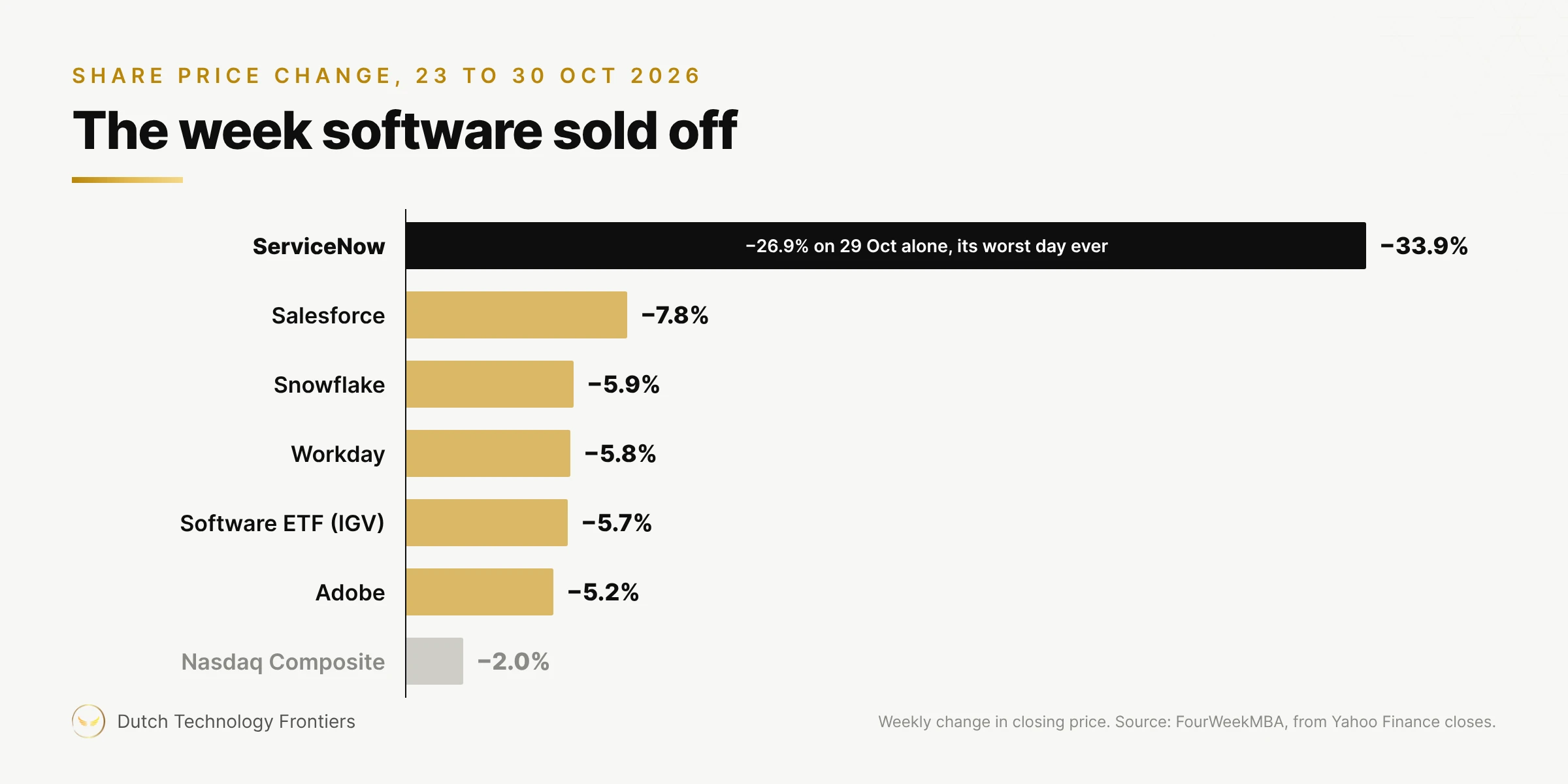
On 29 October, ServiceNow had the worst day in its history. Its shares fell 26.9%.
The quarter itself wasn't bad. Revenue rose 20.5% to $4.1 billion, and subscription revenue grew 21%. What spooked investors was a forecast: growth in current backlog would slow to 18.5% next quarter, from 21% in constant currency. The company said early renewals had pulled some deals into the third quarter, alongside two smaller accounting effects.
The headlines told a bigger story. CNBC said the results "revive AI disruption fears", and the rest of software slid too. In the week to 30 October, Salesforce fell 7.8%, Workday 5.8% and Adobe 5.2%. A broad software fund fell 5.7%, against 2% for the Nasdaq.
The useful lesson here isn't about ServiceNow's shares. A market that prices these companies every second had no time to separate what might be a timing issue from a long-term threat. If you're buying a software company or investing in one, you can't afford that confusion. You get one careful look before you sign, and no share price to sell the next morning.
On the earnings call, one analyst put the question every buyer now has to answer: "whether AI is cannibalistic or accretive to software companies." The answer is different for every company. Diligence is how you find it.
Why seats are the pressure point
Most business software is sold per seat, a price for every person who logs in. AI agents put that model under pressure from two sides.
First, if an agent does part of the work, the customer needs fewer people, and so fewer seats. ServiceNow's CEO, Bill McDermott, described what AI is doing inside his own company as "less people doing extraordinary things." Every one of his customers can do the same sum.
Second, AI features cost money to run. Every call to a model has a price, and a flat seat fee doesn't cover it. In a survey of more than 230 software companies this year, the median target gross margin for AI products was about 50%. Software businesses are used to 70 to 80% or more.
Vendors are already moving. In the same survey, hybrid pricing (a base fee plus usage) remained the most common model, used by 37%, up from 25% a year earlier. Only 5% thought investors preferred pure seat pricing. Gartner, cited by Deloitte, expects at least 40% of enterprise SaaS spend to shift to usage-, agent- or outcome-based pricing by 2030.
None of this happens overnight. Deloitte expects agents to replace parts of enterprise applications over five years or more, starting with customer service. But a company you buy today will still be in your portfolio when it does.
A simple way to see the exposure: how much of the work in the product could an agent do, and how much does the product own?
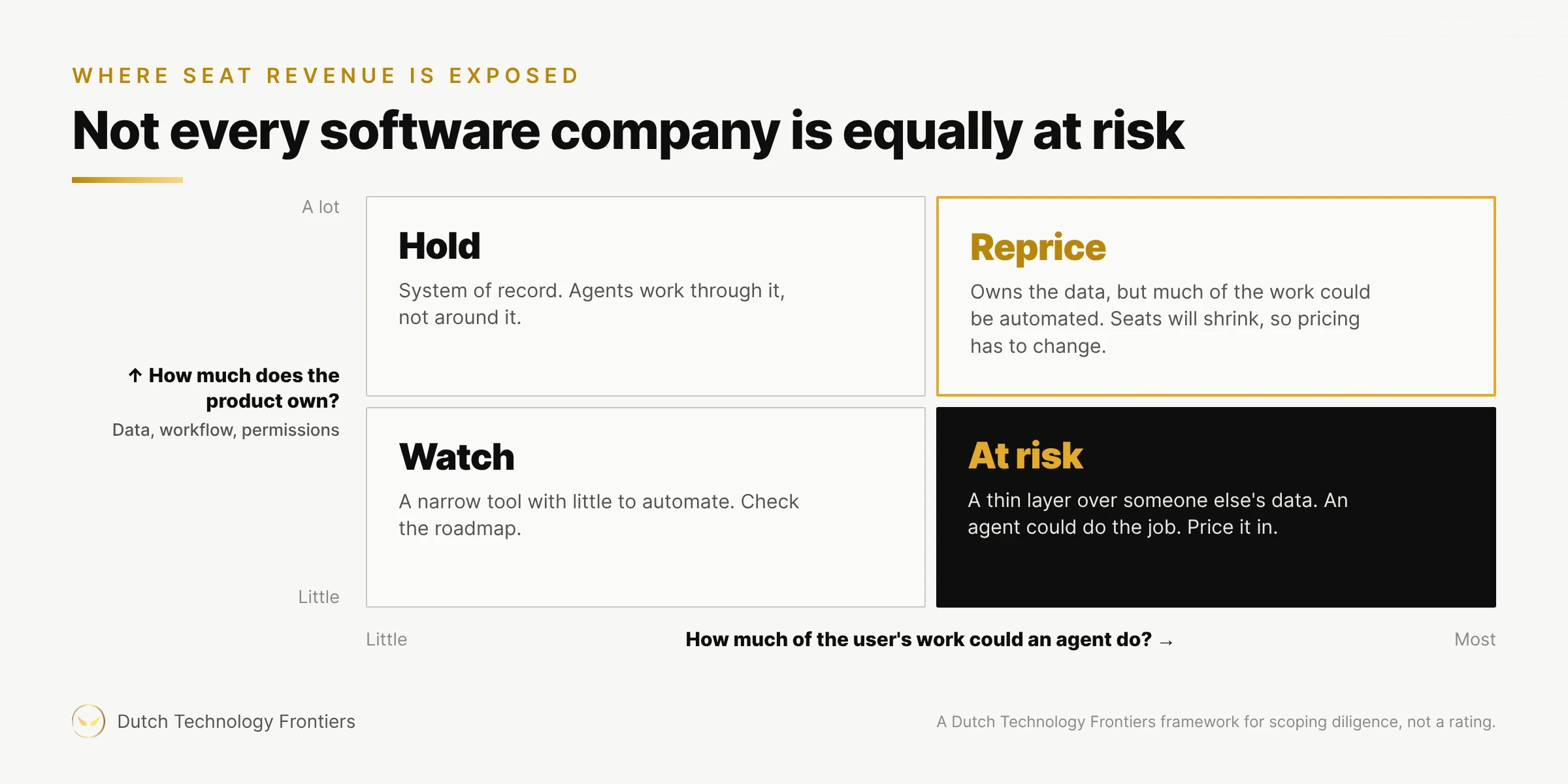
Products that own the data and the workflow have room to change how they charge. Thin tools where an agent could do most of the user's job are the ones to price carefully.
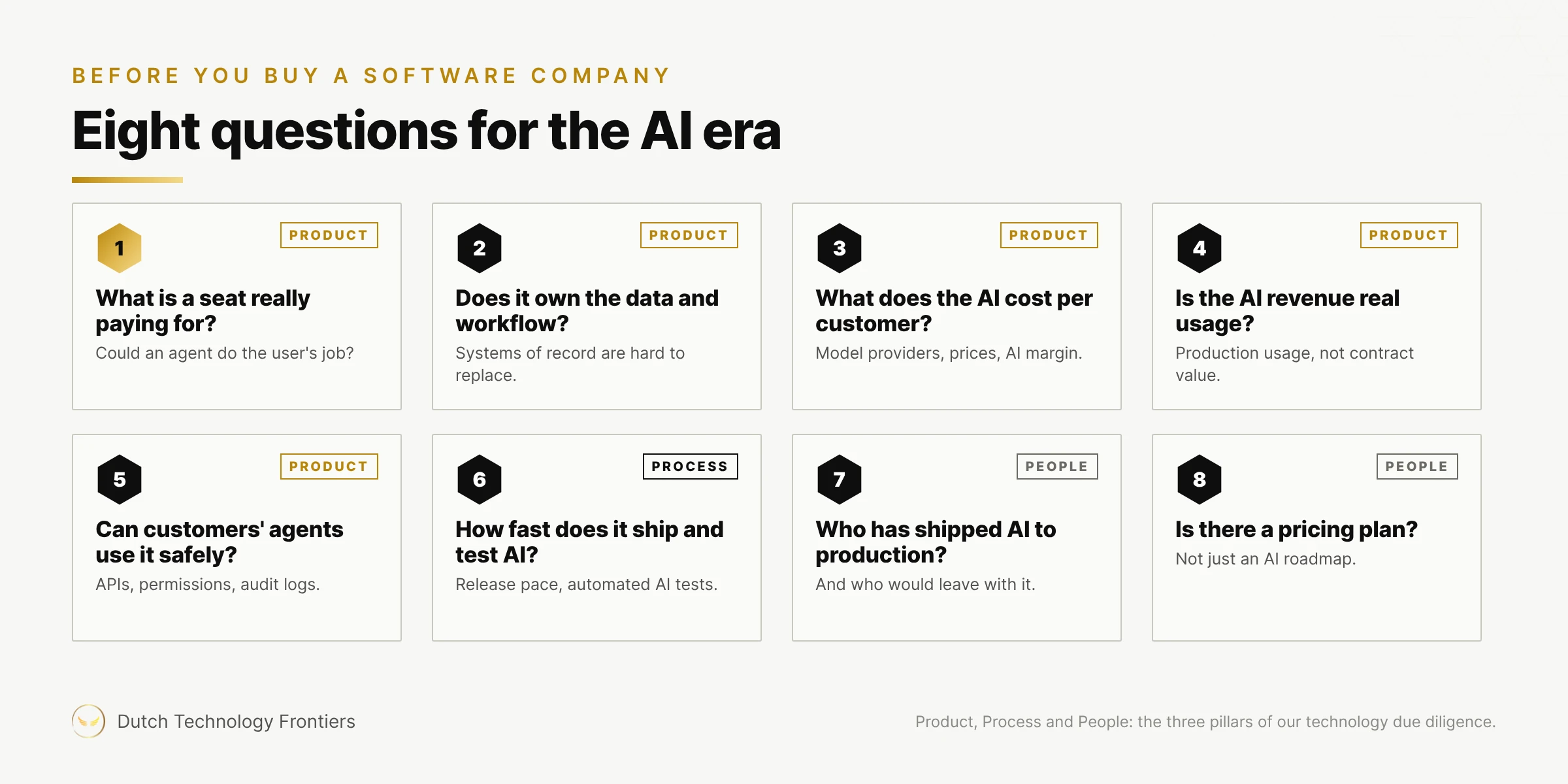
Eight questions to add to your due diligence
These are the questions we'd now add to any technology due diligence on a software business. They sit inside the People, Process, Product framework we set out in AI Technology Due Diligence: People, Process, Product.
Product
What is a seat really paying for? Walk through what a typical user does in the product each day. If an agent could do most of it, the revenue on those seats is exposed, however loyal the customers look today.
Does the product own the data and the workflow? Systems of record, where the data, permissions and audit trail live, are much harder to replace than a screen on top of another system's data.
Where does the AI come from, and what does it cost per customer? Find out which model providers it depends on, what happens if one changes its prices or terms, and the gross margin on AI features once the model bills are paid.
Is the AI revenue real usage? Contract value for AI bundles isn't the same as customers using AI in production. Ask for usage data. ServiceNow, for one, now points to growth in production use of its AI, not just AI contract value.
Can customers' agents use the product safely? Good APIs, fine-grained permissions and audit logs make the product something agents work through. Without them, agents, and the customers behind them, will route around it.
Process
How fast does the team ship and test AI features? Look at how often it releases, and whether there are automated tests for AI behaviour, not just demos that worked once.
People
Who has actually shipped AI into production? One keen engineer and a vendor contract is a very different risk from a team that has run AI features at scale. Check who would walk out with the knowledge.
Is there a pricing plan, not just an AI roadmap? An AI roadmap with no change to pricing means rising costs on a flat fee. Ask how pricing will change and what that does to revenue per customer.
If most of the answers are solid, AI is more likely to grow the business than shrink it. If most are vague, that belongs in the price, or in the terms of the deal.
If you're the one selling
The same eight questions are your homework. Buyers are going to ask them, and "we're working on it" won't hold up for long. Usage data, AI margins and a pricing plan, ready before the data room opens, make diligence shorter and the price easier to defend.
FAQ
What questions should you ask in technical due diligence?
The usual ones cover architecture, code quality, security, scalability and the team. For a software business in 2026, add questions on how exposed its revenue is to AI agents: what a seat pays for, who owns the data, what the AI costs to run, and whether pricing is changing.
Will AI agents replace SaaS?
Some tools, yes, and parts of many others. Gartner, cited by Deloitte, predicts 35% of point-product SaaS tools to be replaced by AI agents or absorbed into larger agent platforms by 2030. Products that own the data and the workflow are better placed than thin tools.
Why is seat-based pricing under pressure?
If agents do part of the work, customers need fewer people and so fewer seats. And AI features cost money every time they run, which a flat fee per user doesn't cover. That's why many vendors are moving to hybrid pricing.
Is this only relevant to SaaS companies?
No. Any business that sells software per user, or that depends on software vendors whose pricing is about to change, should look at the same questions.
Talk to us
The market will keep swinging on every earnings call. A buyer needs a steadier answer, for the one company in front of them. If you're weighing a software deal and want an independent view of what AI does to it, talk to Dutch Technology Frontiers.