

When someone is about to invest in or buy a software company, every question eventually comes back to one: will this product hold up once it's ours?
A pitch deck answers that with growth charts and a roadmap. The codebase answers it with something less polished and a lot more honest.
I'm a full-stack engineer at Dutch Technology Frontiers. Most of my week goes into building and shipping production software in Python, Rails and React. When I open someone else's codebase, I don't read it line by line. I look for a short list of signals that tell me how the product was built, who really understands it, and what it will cost to change. This post walks through those signals, in roughly the order I check them, and ends with five technical due diligence questions you can ask a team without reading any code at all.
The first hour: can anyone actually run this?
The first test is almost boring, and it's the most revealing one. I clone the repository and try to get the product running locally, using only what's written down.
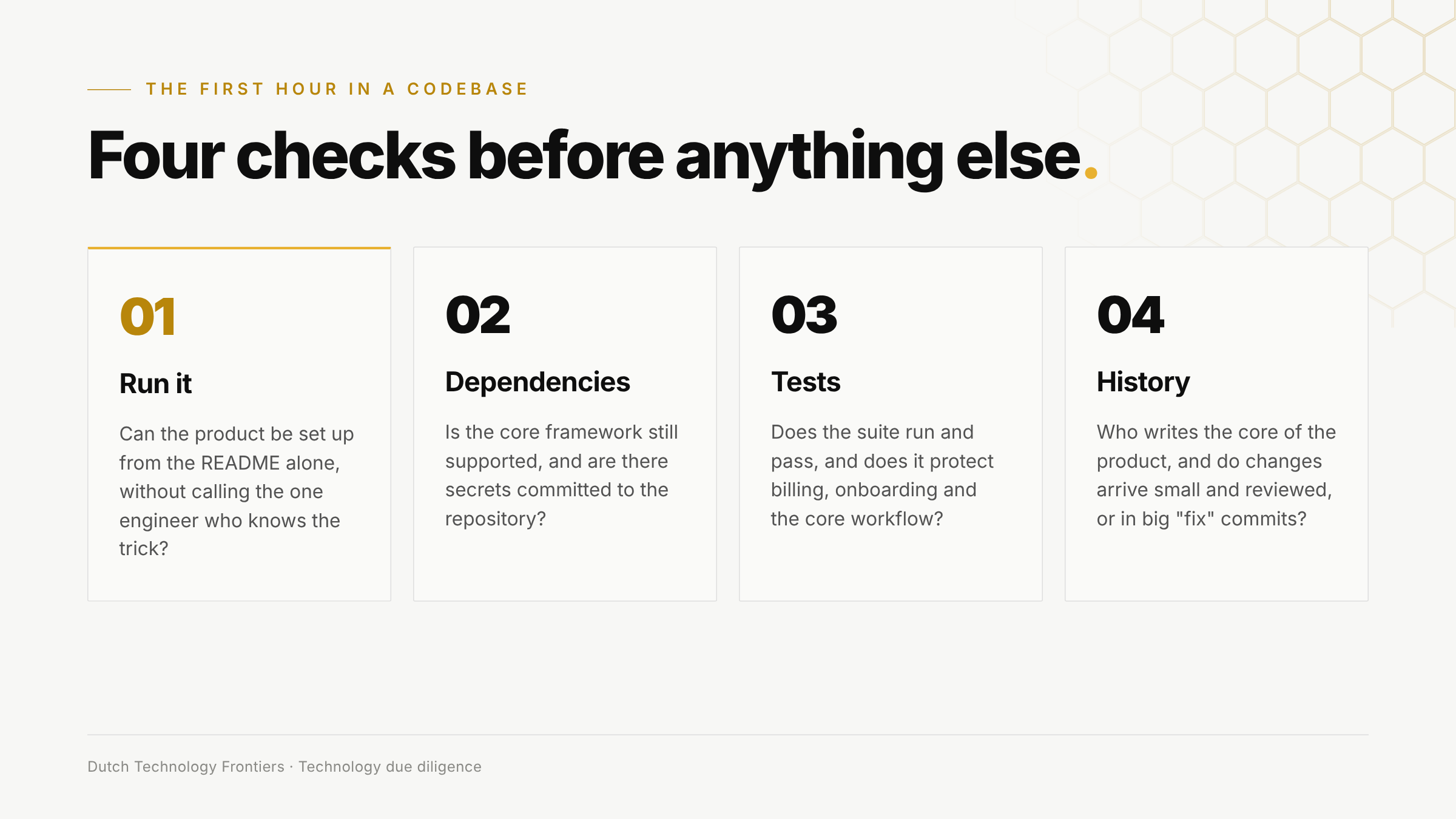
Can it be set up from the README? If setup takes a day, three undocumented steps and a message to the one engineer who knows the trick, that tells you two things. New engineers will be slow to get productive, and a lot of the product's knowledge lives in one person's head.
How old are the dependencies? Every product sits on frameworks and libraries. Being a version or two behind is normal. Running on a framework or runtime that is out of support is different: security patches have stopped, and the upgrade becomes a project with its own budget and timeline. That's a cost a buyer should know about before the deal, not after.
Are there secrets in the repository? API keys, database passwords and access tokens committed to the code are a common finding. They're quick to fix, but they say a lot about how carefully the team treats security day to day.
Do the tests run? I check whether a test suite exists, whether it runs, whether it passes, and what it covers. A suite that's been switched off for months is worse than having none, because it gives everyone false confidence. The question that matters isn't the coverage percentage. It's whether the parts that make money, like billing, onboarding and the core workflow, are protected.
What the commit history says about the team
Version control is a record of how the team actually works, not how they describe it in a meeting.
Who writes the core of the product? If one name is on most of the commits to the most important parts of the code, you've found your key-person risk. If that person has gone quiet in the last few months, you've found a bigger one.
How do changes arrive? Small, regular commits with clear messages usually mean a team that reviews its work and can trace why something changed. Huge commits labelled "fix" or "updates" usually mean the opposite.
What does the pace look like? A steady rhythm is a good sign. Long silences followed by bursts of activity before a release, or before a fundraise, are worth asking about.
None of this is about judging individual engineers. It's about understanding whether the product depends on a healthy team or on a few heroes.
Spotting AI-generated code that nobody owns
Most engineering teams now use AI coding tools, and that's a good thing when it's done well. Code gets written faster. The risk isn't that AI wrote the code. The risk is when nobody on the team understands it well enough to own it.
The signs I look for:
Near-duplicates. The same logic written five times with small differences, where an engineer would normally have made one shared function.
Large additions with no tests. Big blocks of new code landing in a single commit, with nothing around them to check they work.
Generic comments. Comments that describe what the code does in textbook terms, but never why this approach was chosen.
No one can explain it. The simplest test of all: pick a piece of recently added code and ask the team why it works the way it does.
A team that uses AI tools with clear review rules is an asset. A team that ships whatever the tool produces is building up technical debt faster than any human team could on its own.
How code reaches production
The next question is what happens between "the code is written" and "customers are using it".
Is the deploy a pipeline or a person? If releasing depends on one engineer running manual steps from their own laptop, a holiday or a resignation can stop the product from shipping.
Has anyone ever rolled back? Most teams can describe their rollback plan. Far fewer have actually tested it. The answer to "when did you last restore from a backup?" is often a long pause.
Does staging look like production? If the test environment is very different from the live one, bugs will keep surfacing only after release.
How do they find out something is broken? If the answer is "customers tell us", monitoring is missing, and the team is reacting instead of preventing.
Where the cost hides: technical debt worth pricing
Every codebase has technical debt. The useful question is which kind.
Debt that slows you down. Messy code, old naming, awkward structure. It works, it's annoying, and a good team pays it off gradually. It rarely changes a deal.
Debt that blocks you. An unsupported framework under the core product. A data model that can't support the next product line on the roadmap. Payments or customer data with no tests around them. This kind belongs in the conversation about price and in the plan for the first 100 days after the deal, because fixing it takes real time and real money.
Separating the two is most of the value. A list of 200 code smells helps nobody. Three findings with a rough cost and timeline next to each one help an investment committee make a decision.
Five questions to ask without reading a line of code
You don't need to be an engineer to get a good read on a software team. These five technical due diligence questions work in a management meeting, and the way people answer them tells you almost as much as the answer itself.
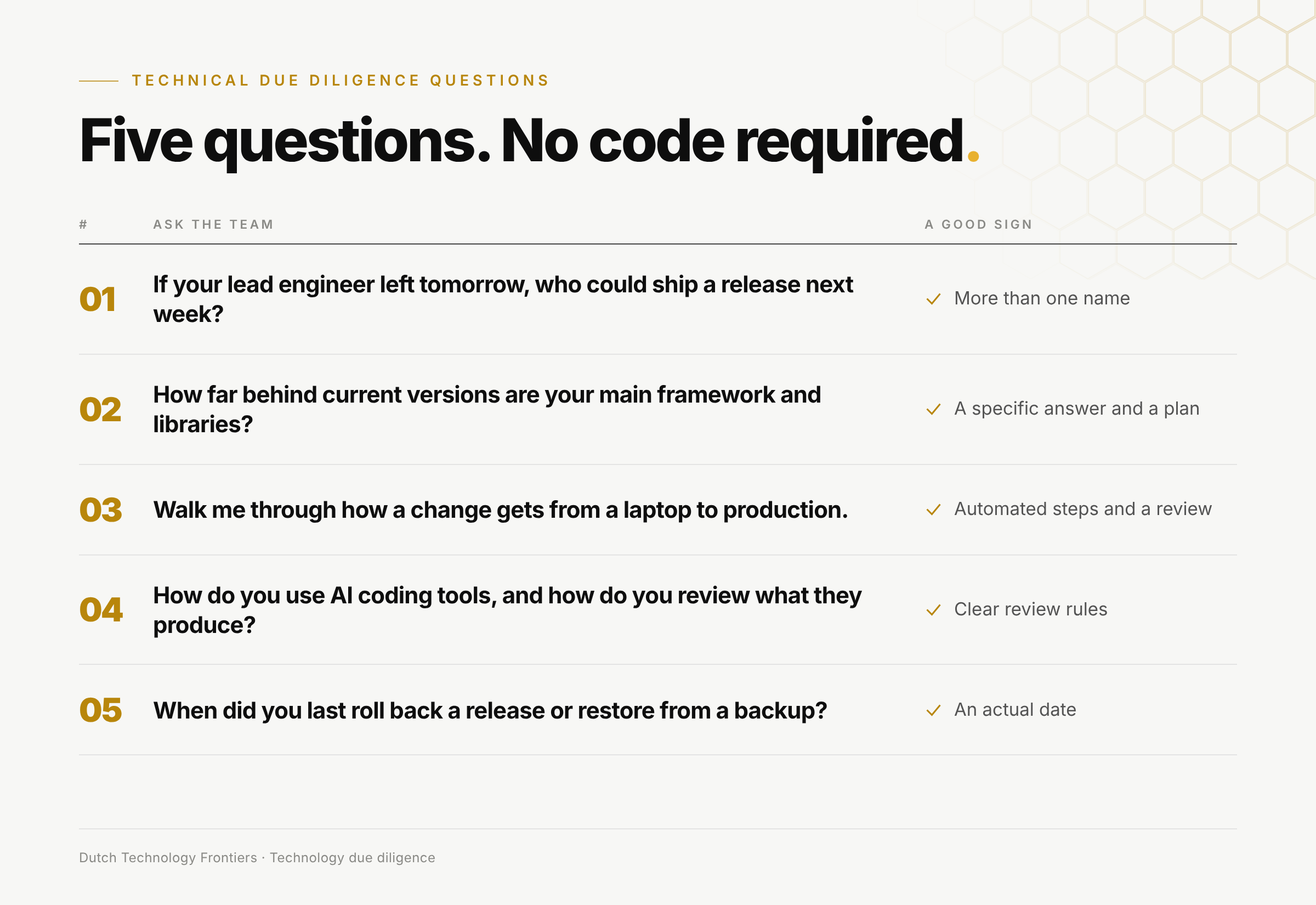
"If your lead engineer left tomorrow, who could ship a release next week?" A good answer names more than one person. A worrying answer is silence, or a single name.
"How far behind current versions are your main framework and libraries?" A good answer is specific and comes with a plan. A worrying answer is "we'd have to check".
"Walk me through how a change gets from a developer's laptop to production." A good answer describes automated steps and a review. A worrying answer involves one person and a list of manual steps.
"How do you use AI coding tools, and how do you review what they produce?" A good answer describes clear rules. A worrying answer is either "we don't" (rarely true now) or "we just ship it".
"When did you last roll back a release or restore from a backup?" A good answer has a date. A worrying answer is "we've never needed to".
How this fits into technology due diligence
At Dutch Technology Frontiers, technology due diligence looks at three things: People, Process and Product. The engineering signals in this post feed all three. The commit history says something about the people, the deploy and review habits describe the process, and the code, dependencies and tests describe the product.
What matters to a buyer is the translation. A finding like "the framework is out of support" only becomes useful once it's turned into a risk, a rough cost to fix and a timeline, so it can inform the price and the first 100 days. A preliminary assessment takes five business days, and a full technology due diligence takes two to three weeks.
And when the findings point to a gap in senior technical leadership after the deal, that's where fractional tech leadership comes in: someone senior who owns the plan and works with the team that's already there.
If you're assessing a software company, or getting your own product ready for a raise or a sale, talk to us about technology due diligence.
Frequently asked questions
What are the most important technical due diligence questions? Start with key-person risk (who could ship a release if the lead engineer left), how outdated the core framework and dependencies are, how code reaches production, how AI-generated code is reviewed, and whether backups and rollbacks have actually been tested.
How long does a technology due diligence take? At Dutch Technology Frontiers, a preliminary assessment takes five business days and a full technology due diligence takes two to three weeks.
Is AI-generated code a red flag in due diligence? Not on its own. It becomes a risk when there are no review rules, no tests around generated code, and nobody on the team can explain how it works.